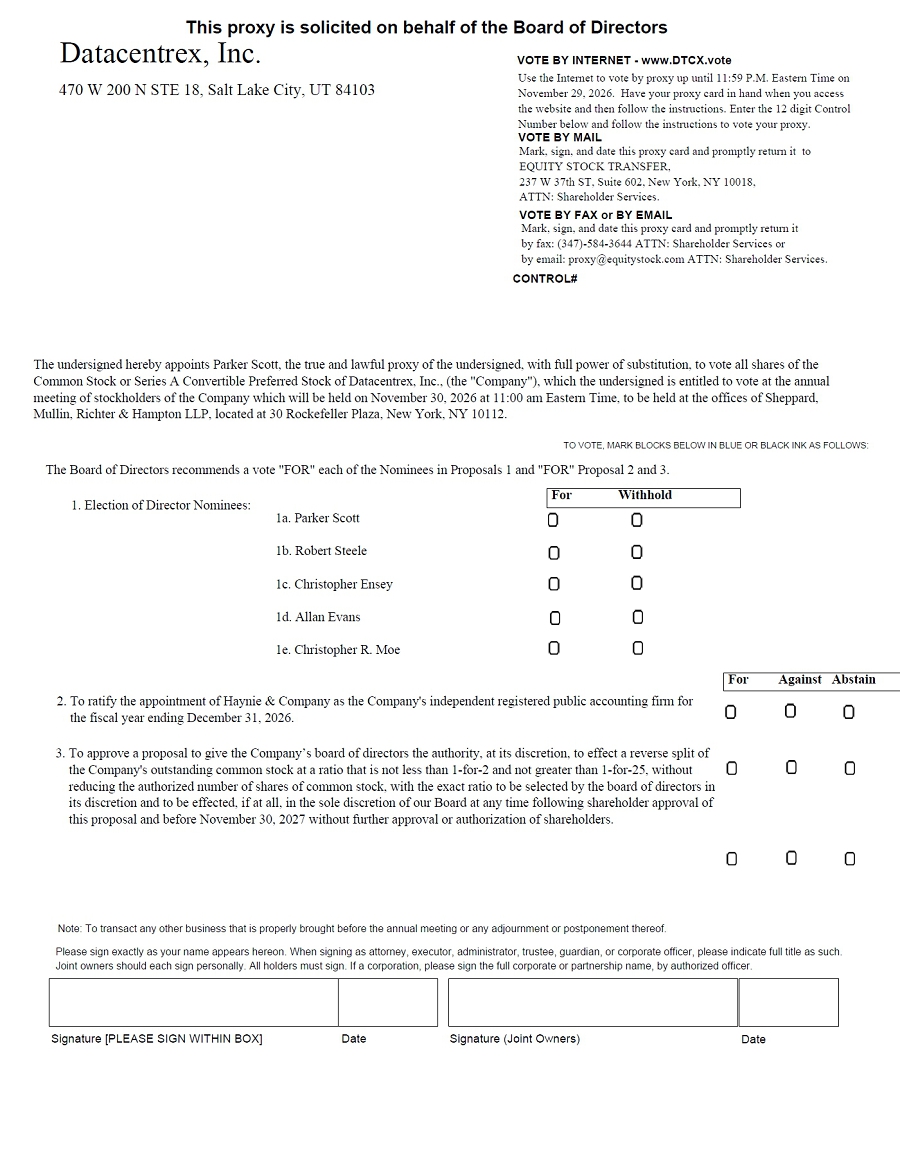
PRE 14A: Preliminary proxy statement not related to a contested matter or merger/acquisition
Published on October 5, 2026
UNITED
STATES
SECURITIES AND EXCHANGE COMMISSION
Washington, D.C. 20549
Proxy
Statement Pursuant to Section 14(a) of the Securities Exchange Act of 1934
(Amendment No. )
| Filed by the Registrant | ☒ |
| Filed by a Party other than the Registrant | ☐ |
Check the appropriate box:
| ☒ | Preliminary Proxy Statement |
| ☐ | Confidential, for Use of the Commission Only (as permitted by Rule 14a-6(e)(2)) |
| ☐ | Definitive Proxy Statement |
| ☐ | Definitive Additional Materials |
| ☐ | Soliciting Material under §240.14a-12 |
(Name of Registrant as Specified In Its Charter)
(Name of Person(s) Filing Proxy Statement, if other than the Registrant)
Payment of Filing Fee (Check all boxes that apply):
| ☒ | No fee required. |
| ☐ | Fee paid previously with preliminary materials. |
| ☐ | Fee computed on table in exhibit required by Item 25(b) per Exchange Act Rules 14a-6(i)(1) and 0-11. |

DATACENTREX,
INC.
470 W 200 N STE 18
Salt Lake City, UT 84103
NOTICE
OF ANNUAL MEETING OF SHAREHOLDERS
TO BE HELD ON NOVEMBER 30, 2026
To the Shareholders of Datacentrex, Inc.:
The 2026 Annual Meeting of Shareholders (the “2026 Annual Meeting”) of Datacentrex, Inc., a Nevada corporation (the “Company,” “we,” “us,” or “our”), will be held on Monday, November 30, 2026, at 11:00 a.m. Eastern Time. The 2026 Annual Meeting will be held at the offices of Sheppard, Mullin, Richter & Hampton LLP, located at 30 Rockefeller Plaza, New York, NY 10112.
At the 2026 Annual Meeting, the holders of our outstanding common stock and Series A Preferred Convertible Voting Stock (the “Series A Preferred Stock”) will act on the following matters:
| 1. | To elect members of the Company’s board of directors (the “Board”) to serve for a one-year term to expire at the 2027 annual meeting of shareholders; |
| 2. | To ratify the appointment of Haynie & Company (“Haynie”) as our independent registered public accounting firm for the fiscal year ending December 31, 2026; |
| 3. | To approve a proposal to give our Board the authority, at its discretion, to effect a reverse split of our outstanding common stock at a ratio that is not less than 1-for-2 and not greater than 1-for-25, without reducing the authorized number of shares of our common stock, with the exact ratio to be selected by our Board in its discretion and to be effected, if at all, in the sole discretion of our Board at any time following shareholder approval of this proposal and before November 30, 2027 without further approval or authorization of our shareholders (the “Reverse Stock Split Proposal”); and |
| 4. | To transact such other business as may properly be brought before the 2026 Annual Meeting or any adjournment or postponement thereof. |
Our Board unanimously recommends that you vote: “FOR” the election of our Board’s director nominees (Proposal 1); “FOR” the ratification of the appointment of Haynie as our independent registered public accounting firm for the fiscal year ending December 31, 2026 (Proposal 2); and “FOR” the approval of the Reverse Stock Split Proposal (Proposal 3).
Instead of mailing a printed copy of our proxy materials to all of our shareholders, we provide access to these materials via the internet. This reduces the amount of paper necessary to produce these materials as well as the costs associated with mailing these materials to all shareholders. Accordingly, on or about __________, 2026, we will begin mailing a Notice of Internet Availability of Proxy Materials (the “Notice”) to all shareholders of record on our books at the close of business on _________, 2026, the record date for the 2026 Annual Meeting, and will post our proxy materials on the website referenced in the Notice. As more fully described in the Notice, shareholders may choose to access our proxy materials on the website referred to in the Notice or may request to receive a printed set of our proxy materials. In addition, the Notice and website provide information regarding how you may request to receive proxy materials in printed form by mail, or electronically by email, on an ongoing basis.
If you are a shareholder of record, you may vote in one of the following ways:
| ● | Vote over the internet, by going to www.DTCX.vote (have your Notice or proxy card in hand when you access the website); |
| ● | Vote by mail, if you received (or requested and received) a printed copy of the proxy materials, by returning the enclosed proxy card (signed and dated) in the envelope provided; | |
| ● | Vote by fax by faxing the enclosed proxy card (signed and dated)) to 347-584-3644; |
| ● | Vote by phone by calling 1-212-575-5757; | |
| ● | Vote by email (include your Control ID) at proxy@equitystock.com; or |
| ● | Vote in person by attending and voting at the 2026 Annual Meeting. |
If your shares are held in “street name,” meaning that they are held for your account by a broker or other nominee, you will receive instructions from the holder of record that you must follow for your shares to be voted.
Whether or not you plan to attend the 2026 Annual Meeting, we urge you to take the time to vote your shares.
If you have any questions or need assistance voting your shares, please contact the Company’s Corporate Secretary.
| By Order of the Board of Directors, | |
| Parker Scott | |
| Chief Executive Officer and Director | |
| Salt Lake City, UT | |
| __________, 2026 |
DATACENTREX,
INC.
470 W 200 N STE 18
Salt Lake City, UT 84103
PROXY
STATEMENT
FOR THE ANNUAL MEETING OF SHAREHOLDERS
TO BE HELD ON NOVEMBER 30, 2026
IMPORTANT NOTICE REGARDING THE AVAILABILITY OF PROXY MATERIALS FOR THE 2026 Annual Meeting TO BE HELD ON MONDAY, NOVEMBER 30, 2026
Copies of this proxy statement, the form of proxy card and the Annual Report on Form 10-K for the fiscal year ended December 31, 2025 (the “2025 Annual Report”) are available without charge at www.DTCX.vote, by telephone at 1-212-575-5757, by email to proxy@equitystock.com, or by notifying our Corporate Secretary, in writing, at Datacentrex, Inc., 470 W 200 N STE 18, Salt Lake City, UT 84103.
The board of directors (“Board” or “Board of Directors”) of Datacentrex, Inc. (“Company,” “we,” “us,” or “our”) is soliciting the enclosed proxy for use at its 2026 annual meeting of shareholders (the “2026 Annual Meeting” or “Annual Meeting”). The 2026 Annual Meeting will be held on November 30, 2026 at 11:00 a.m. Eastern Time at the offices of Sheppard, Mullin, Richter & Hampton LLP, located at 30 Rockefeller Plaza, New York, NY 10112.
On or about _________, 2026, we will begin mailing a Notice of Internet Availability of Proxy Materials (the “Notice”) to our shareholders (other than those who previously requested electronic or paper delivery of proxy materials), directing shareholders to a website where they can access our proxy materials, including this proxy statement and the 2025 Annual Report, and view instructions on how to vote. If you would prefer to receive a paper copy of our proxy materials, please follow the instructions included in the Notice. If you have previously elected to receive our proxy materials electronically, you will continue to receive access to those materials via e-mail unless you elect otherwise.
TABLE OF CONTENTS
| i |
QUESTIONS AND ANSWERS ABOUT THIS PROXY MATERIAL AND VOTING
Why did I Receive a Notice of Internet Availability of Proxy Materials in the Mail instead of a Full Set of Proxy Materials?
We are pleased to take advantage of the Securities and Exchange Commission (“SEC”) rule that allows companies to furnish their proxy materials over the internet. Accordingly, we have sent to our shareholders of record a Notice of Internet Availability of Proxy Materials. Instructions on how to access the proxy materials over the internet free of charge or to request a paper copy may be found in the Notice. Our shareholders may request to receive proxy materials in printed form by mail or electronically on an ongoing basis. A shareholder’s election to receive proxy materials by mail or electronically will remain in effect until the shareholder changes its election.
What Does it Mean if I Receive More than One Notice?
If you receive more than one Notice, your shares may be registered in more than one name or in different accounts. Please follow the voting instructions on each Notice to ensure that all of your shares are voted.
How do I attend the Annual Meeting?
The Annual Meeting will be held on November 30, 2026, at 11:00 a.m. Eastern Time at the offices of Sheppard, Mullin, Richter & Hampton LLP, located at 30 Rockefeller Plaza, New York, NY 10112.
Who May Attend the Annual Meeting?
Only record holders and beneficial owners of our common stock and Series A Preferred Stock, or their duly authorized proxies, may attend the Annual Meeting. If your shares of common stock are held in street name, you will need to bring a copy of a brokerage statement or other documentation reflecting your stock ownership as of the Record Date (as defined herein).
Who is Entitled to Vote?
The Board has fixed the close of business on _________, 2026 as the record date (the “Record Date”) for the determination of shareholders entitled to notice of, and to vote at, the Annual Meeting or any adjournment or postponement thereof. On the Record Date, there were _________ shares of common stock issued and outstanding and _________ shares of Series A Preferred Stock issued and outstanding. Each share of common stock represents one vote that may be voted on each proposal that may come before the Annual Meeting. Each holder of Series A Preferred Stock as of the Record Date is entitled to vote together with the common stock on an as-converted basis; provided, however, that each holder of Series A Preferred Stock shall be limited to voting a number of votes equal to 9.99% of all shares entitled to vote on an as-converted basis, except as otherwise required by law. Holders of Series D Preferred Stock are not entitled to vote on any of the matters described in this proxy statement, and shares of Series D Preferred Stock are not included in the number of shares entitled to vote as of the Record Date.
What is the Difference Between Holding Shares as a Record Holder and as a Beneficial Owner (Holding Shares in Street Name)?
If your shares are registered in your name with our transfer agent, Equity Stock Transfer LLC, you are the “record holder” of those shares. If you are a record holder, these proxy materials have been provided directly to you by the Company.
If your shares are held in a stock brokerage account, a bank or other holder of record, you are considered the “beneficial owner” of those shares held in “street name.” If your shares are held in street name, these proxy materials have been forwarded to you by that organization. The organization holding your account is considered to be the shareholder of record for purposes of voting at the Annual Meeting. As the beneficial owner, you have the right to instruct this organization on how to vote your shares.
| 1 |
What am I Voting on?
There are three matters scheduled for a vote:
| 1. | To elect five members to our Board of Directors to serve for a one-year term to expire at the 2027 annual meeting of shareholders; |
| 2. | To ratify the appointment of Haynie & Company (“Haynie”) as our independent registered public accounting firm for our fiscal year ending December 31, 2026; and |
| 3. | To approve a proposal to give our Board the authority, at its discretion, to effect a reverse split of our outstanding common stock at a ratio that is not less than 1-for-2 and not greater than 1-for-25, without reducing the authorized number of shares of our common stock, with the exact ratio to be selected by our Board in its discretion and to be effected, if at all, in the sole discretion of our Board at any time following shareholder approval of this proposal and before November 30, 2027 without further approval or authorization of our shareholders (the “Reverse Stock Split Proposal”). |
What if another matter is properly brought before the Annual Meeting?
The Board knows of no other matters that will be presented for consideration at the Annual Meeting. If any other matters are properly brought before the Annual Meeting, it is the intention of the person named in the accompanying proxy to vote on those matters in accordance with his best judgment.
How Do I Vote?
Shareholders of Record
For your convenience, record holders of our common stock and Series A Preferred Stock have six methods of voting:
| 1. | Vote over the internet, by going to www.DTCX.vote (have your Notice or proxy card in hand when you access the website); |
| 2. | Vote by mail, if you received (or requested and received) a printed copy of the proxy materials, by returning the enclosed proxy card (signed and dated) in the envelope provided; |
| 3. | Vote by fax by faxing the enclosed proxy card (signed and dated)) to 347-584-3644; |
| 4. | Vote by phone by calling 1-212-575-5757; |
| 5. | Vote by email (include your Control ID) to proxy@equitystock.com; or |
| 6. | Vote in person by attending and voting at the 2026 Annual Meeting. |
Beneficial Owners of Shares Held in Street Name
If your shares are held in street name, the organization that holds your shares may vote your shares only on certain of the proposals described in this proxy statement without receiving voting instructions from you. If you hold your shares in street name and you do not submit voting instructions to the organization that holds your shares, whether that organization may exercise its discretion to vote your shares depends on whether a particular proposal is considered a “routine” or “non-routine” matter under the rules of the New York Stock Exchange applicable to securities intermediaries (even though we are a Nasdaq-listed company).
We expect the organization that holds your shares will have discretionary voting authority to vote your shares on proposals considered to be “routine” matters even if that organization does not receive voting instructions from you. However, certain organizations may elect not to vote shares without an instruction from the beneficial owner even if they have discretionary authority to do so. We expect the ratification of the appointment of Haynie (Proposal 2) and the approval of the Reverse Stock Split Proposal (Proposal 3) to be considered “routine” matters.
| 2 |
On the other hand, if you do not provide voting instructions to the organization that holds your shares, we do not expect that those shares will be voted on any proposal considered a “non-routine” matter because the organization that holds your shares typically lacks discretionary authority to vote uninstructed shares on non-routine matters. We expect the election of directors (Proposal 1) to be considered a “non-routine” matter.
Organizations may reach conclusions regarding their ability to vote your shares on a particular proposal that differ from our expectations expressed in this proxy statement. Accordingly, we encourage you to provide voting instructions to the organization that holds your shares on all proposals to ensure that your vote is counted. We expect that organizations will vote shares as you have instructed.
We provide internet proxy voting to allow you to vote your shares online, with procedures designed to ensure the authenticity and correctness of your proxy vote instructions. However, please be aware that you must bear any costs associated with your internet access, such as usage charges from internet access providers and telephone companies.
How Many Votes do I Have?
On each matter to be voted upon, you have one vote for each share of common stock you own as of the close of business on the Record Date. If you hold shares of Series A Preferred Stock, you are entitled to vote together with the common stock on an as-converted basis; provided, however, that each holder of Series A Preferred Stock shall be limited to voting a number of votes equal to 9.99% of all shares entitled to vote on an as-converted basis, except as otherwise required by law. If you hold shares of Series D Preferred Stock, those shares do not carry voting rights and are not entitled to vote at the Annual Meeting.
Is My Vote Confidential?
Yes, your vote is confidential. Only the inspector of election, individuals who help with processing and counting your votes and persons who need access for legal reasons will have access to your vote. This information will not be disclosed, except as required by law.
What Constitutes a Quorum?
To carry on business at the Annual Meeting, we must have a quorum. A quorum is present when holders of one-third of the shares entitled to vote as of the Record Date, are represented in person or by proxy. Thus, _________ shares (including shares of common stock and shares of Series A Preferred Stock counted on an as-converted basis, subject to the 9.99% blocker) must be represented in person or by proxy to have a quorum at the Annual Meeting. Your shares will be counted towards the quorum only if you submit a valid proxy (or one is submitted on your behalf by your broker, bank or other nominee) or if you vote in person at the Annual Meeting. Abstentions and broker non-votes will be counted towards the quorum requirement. Shares owned by us are not considered outstanding or considered to be present at the Annual Meeting. If a quorum is not present by attendance at the 2026 Annual Meeting or represented by proxy, the shareholders present by attendance at the meeting or by proxy may adjourn the 2026 Annual Meeting until a quorum is present.
How Will my Shares be Voted if I Give No Specific Instruction?
With regard to shares that are not held in street name, shares must be voted as a shareholder has instructed. If there is a matter on which a shareholder of record has given no specific instruction but has authorized us generally to vote its shares on its behalf, they will be voted as follows:
| 1. | “FOR” the election of each of the five director nominees to our Board of Directors to serve for a one-year term to expire at the 2027 annual meeting of shareholders; |
| 2. | “FOR” the ratification of the appointment of Haynie as our independent registered public accounting firm for our fiscal year ending December 31, 2026; and |
| 3. | “FOR” the approval of the Reverse Stock Split Proposal. |
| 3 |
This authorization would exist, for example, if a shareholder of record merely signs, dates and returns the proxy card but does not indicate how its shares are to be voted on one or more proposals. If other matters properly come before the Annual Meeting and you do not provide specific voting instructions, your shares will be voted at the discretion of the proxy.
If your shares are held in street name, we expect that banks, brokers and other such holders of record will vote shares as you have instructed. Please see “What is a Broker Non-Vote?” below regarding the ability of banks, brokers and other such holders of record to vote the uninstructed shares of their customers or other beneficial owners.
How are Votes Counted?
Votes will be counted by the inspector of election appointed for the Annual Meeting, who will separately count, for the election of directors, “FOR” and “WITHHOLD” abstentions and broker non-votes; and, with respect to the other proposals, votes “FOR” and “AGAINST,” abstentions and broker non-votes.
What is a Broker Non-Vote?
A “broker non-vote” occurs if the organization that holds your shares cannot vote your shares on a particular matter because it has not received instructions from you and it does not have discretionary voting authority on that matter or because the organization that holds your shares chooses not to vote on a matter for which it does have discretionary voting authority.
What is an Abstention?
An abstention is a shareholder’s affirmative choice to decline to vote on a proposal. Our Amended and Restated Bylaws, as amended (“Bylaws”), provide that an action of our shareholders (other than the election of directors) is only approved if a majority of the number of shares of stock present and entitled to vote thereon vote in favor of such action.
How Many Votes are Needed for Each Proposal to Pass?
| Proposal | Vote Required | |
| Election of each of the five director nominees to our Board of Directors | Plurality of the votes cast (the five directors nominees receiving the most “FOR” votes). | |
| Ratification of the appointment of Haynie as our independent registered public accounting firm for our fiscal year ending December 31, 2026 | A majority of the votes entitled to vote thereon and present at the Annual Meeting. | |
| Reverse Stock Split Proposal | A majority of the votes entitled to vote thereon and present at the Annual Meeting |
What Are the Voting Procedures?
In voting by proxy with regard to the election of directors, you may vote “for” or “withhold” as to each nominee. With regard to other proposals, you may vote “for,” “against” or “abstain” for each proposal. You should specify your respective choices on the accompanying proxy card or your vote instruction form.
Is My Proxy Revocable?
You may revoke your proxy and reclaim your right to vote at any time before your proxy is voted by giving written notice to the Corporate Secretary of Datacentrex, Inc., by delivering a properly completed, later-dated proxy card or vote instruction form or by voting in person at the Annual Meeting. All written notices of revocation and other communications with respect to revocations of proxies should be addressed to: Datacentrex, Inc., 470 W 200 N STE 18, Salt Lake City, UT 84103. Your most current proxy card or internet proxy is the one that will be counted.
| 4 |
Who is Paying for the Expenses Involved in Preparing and Mailing this Proxy Statement?
All of the expenses involved in preparing, assembling and mailing these proxy materials and all costs of soliciting proxies will be paid by us. In addition to the solicitation by mail, proxies may be solicited by our officers and other employees by telephone or in person. Such persons will receive no compensation for their services other than their regular salaries. Arrangements will also be made with brokerage houses and other custodians, nominees and fiduciaries to forward solicitation materials to the beneficial owners of the shares held of record by such persons, and we may reimburse such persons for reasonable out of pocket expenses incurred by them in forwarding solicitation materials. We do not anticipate hiring an agency to solicit votes from shareholders at this time; however, if we determine that such action would be appropriate or necessary, we would pay the cost of such service.
Do I Have Dissenters’ Rights of Appraisal?
Our shareholders do not have appraisal rights with respect to the matters to be voted upon at the Annual Meeting.
How can I Find out the Results of the Voting at the Annual Meeting?
Preliminary voting results will be announced at the Annual Meeting. In addition, final voting results will be disclosed in a Current Report on Form 8-K that we expect to file with the SEC within four business days after the Annual Meeting. If final voting results are not available to us in time to file a Current Report on Form 8-K with the SEC within four business days after the Annual Meeting, we intend to file a Current Report on Form 8-K to publish preliminary results and, within four business days after the final results are known to us, file an additional Current Report on Form 8-K to publish the final results.
When are Shareholder Proposals Due for the 2027 Annual Meeting?
Shareholders who intend to have a proposal considered for inclusion in our proxy materials for presentation at our 2027 annual meeting of shareholders (the “2027 Annual Meeting”) must submit the proposal to us at our corporate headquarters no later than _________, which proposal must be made in accordance with the provisions of Rule 14a-8 of the Securities Exchange Act of 1934, as amended (the “Exchange Act”). In the event the date of the 2027 Annual Meeting has been changed by more than 30 days from the date of the 2026 Annual Meeting, shareholders who intend to have a proposal considered for inclusion in our proxy materials for presentation at our 2027 Annual Meeting must submit the proposal to us at our corporate headquarters no later than a reasonable time before we begin to print and send our proxy materials for our 2027 Annual Meeting.
Shareholders who intend to present a proposal at our 2027 Annual Meeting without inclusion of the proposal in our proxy materials are required to provide notice of such proposal to our Corporate Secretary so that such notice is received by our Corporate Secretary at our principal executive office on or after _________ but no later than _________; provided, however, in the event that the 2027 Annual Meeting occurs on a date that is not within 30 days before or after the anniversary date of the 2026 Annual Meeting, notice of such proposal must be received by our Corporate Secretary no later than the close of business on the 10th day following the day on which such notice of the date of the 2027 Annual Meeting is mailed or public disclosure of the date of the 2027 Annual Meeting is made, whichever first occurs.
In order for shareholders to give timely notice under the universal proxy rules of an intent to solicit proxies in support of director nominees other than our nominees for the 2027 Annual Meeting, notice must be submitted by _________; provided, however, in the event that the date of the 2027 Annual Meeting has changed by more than 30 calendar days from the anniversary date of the 2026 Annual Meeting, then notice of such proxy solicitation must be provided by the later of 60 days prior to the date of the 2027 Annual Meeting or the 10th calendar day following the day on which a public announcement of the date of the 2027 Annual Meeting is first made by us and such notice must include all the information required by Rule 14a-19(b) under the Exchange Act and such shareholders must comply with all of the requirements of Rule 14a-19 under the Exchange Act.
Shareholders are also advised to review our Bylaws, which contain additional requirements relating to shareholder proposals and director nominations, including who may submit them and what information must be included.
We reserve the right to reject, rule out of order or take other appropriate action with respect to any proposal that does not comply with these and other applicable requirements.
Do the Company’s Officers and Directors have an Interest in Any of the Matters to Be Acted Upon at the Annual Meeting?
Members of the Board have an interest in the election to the Board of the five director nominees set forth herein (Proposal 1). Members of the Board and executive officers of the Company do not have any interest in the ratification of the appointment of the Company’s independent registered public accounting firm (Proposal 2) or any substantial interest, directly or indirectly, in the Reverse Stock Split Proposal (Proposal 3) except to the extent of their ownership of shares of our common stock and/or securities exercisable for or convertible into shares of our common stock, which shares and securities would be subject to the same proportionate adjustment based on the reverse stock split ratio approved by the Board as all other outstanding shares of our common stock and securities exercisable for or convertible into shares of our common stock.
| 5 |
PROPOSAL 1:
ELECTION OF DIRECTORS
Our Board currently consists of five directors, and their terms will expire at the 2026 Annual Meeting. Directors are elected at the annual meeting of shareholders each year and hold office until their resignation or removal or their successors are duly elected and qualified.
Parker Scott, Robert Steele, Christopher Ensey, Allan Evans, and Christopher R. Moe have each been nominated to serve as directors and have agreed to stand for election. If the nominees are elected at the 2026 Annual Meeting, then each nominee will serve for a one-year term expiring at the 2027 Annual Meeting and until his successor is duly elected and qualified.
If no contrary indication is made, with the potential exception of proxies submitted for shares held in street name, proxies will be voted “FOR” Parker Scott, Robert Steele, Christopher Ensey, Allan Evans and Christopher R. Moe or, in the event that any such individual is unable to serve as a director at the time of the election (which is not currently expected), for any nominee who is designated by our Board to fill the vacancy.
Recommendation of our Board
Our Board unanimously recommends that the shareholders vote “FOR” the election of all of our director nominees at the 2026 Annual Meeting.
Nominees for Election to the Board
| Nominee | Age as of the Record Date | Position(s) | ||
| Parker Scott | 31 | Chief Executive Officer and Chairman | ||
| Robert Steele | 60 | Chief Financial Officer and Director | ||
| Christopher Ensey | 47 | Director | ||
| Allan Evans | 43 | Director | ||
| Christopher R. Moe | 70 | Director |
Nominees for Election to the Board for a Term Expiring at the 2027 Annual Meeting of Shareholders
Parker Scott - Chief Executive Officer and Chairman
Mr. Scott has served as Chief Executive Officer and Chairman of the Company since December 2025. Mr. Scott is a finance and business development executive with over a decade of experience in capital markets, digital asset mining, biotechnology, and advanced energy industries. From January 2025 until December 2025, he served as Chief Executive Officer of Dogehash Technologies, Inc. (“Dogehash”), leading the company’s strategy to become one of the most competitive and profitable Scrypt-based miners in North America. Prior to joining Dogehash, Mr. Scott served as Chief Financial Officer of PolarityBio, where he was responsible for financial strategy, capital formation, and investor engagement in connection with the company’s regenerative medicine platform. He previously held the position of Vice President of Business Development at ASP Isotopes, Inc. (NASDAQ: ASPI), a nuclear energy and Advanced Isotope commercialization company, where he focused on strategic partnerships, fundraising, and market development. In addition to his operating roles, Mr. Scott has provided extensive advisory and consulting services to companies in the digital asset mining industry, assisting with large-scale infrastructure development, fundraising, and investor relations. He has worked closely with both private and public companies in the sector, bringing a unique combination of capital markets experience and operational expertise to the rapidly evolving digital asset ecosystem. Mr. Scott began his career in global equity research at Goldman Sachs and later at a special situations hedge fund, where he specialized in market analysis, capital allocation, and portfolio strategy. Since 2018, he has founded, advised, and managed companies in the cryptocurrency, biotechnology and energy industries, with a focus on financial structuring, business development, and shareholder value creation. We believe Mr. Scott is qualified to serve as a director of the Company because of his experience as Chief Executive Officer of Dogehash.
| 6 |
Robert Steele - Chief Financial Officer and Director
Mr. Steele served as Chief Executive Officer of the Company from October 2020 until December 2025 and has served as a director of the Company since October 2020. Since August 2026, Mr. Steele serves as President of Atlas Signal Inc., a company that provides sponsored report coverage of public companies Since October 2019, Mr. Steele has operated a consulting business that has provided investor relations, financial, sales and marketing consulting services to various clients. Mr. Steele was the Director of Client Positioning at IRTH Communications, LLC from January 2017 to September 2019. From May 2016 through December 2016, Mr. Steele was an independent consultant rendering sales, marketing and investor relations services. From January 2010 to May 2016, Mr. Steele was the President of Rightscorp, Inc. (“Rightscorp”). While at Rightscorp, Mr. Steele designed and deployed patented intellectual property software as a service (SaaS) tools that were used by major brands like Warner Bros. to protect their intellectual property. As President of Rightscorp, Mr. Steele led the design of the software used by clients like Sony/ATV and BMG. BMG successfully used Mr. Steele’s technology to win a landmark $25 million judgment against Cox Communications for copyright infringement. Mr. Steele holds a BS in Electronic and Computer Engineering from George Mason University. We believe Mr. Steele is qualified to serve as a member of the Board due to his extensive experience as an executive at publicly traded companies and his demonstrated expertise in technology.
Christopher Ensey - Director
Mr. Ensey has served on the Board since October 2025. From 2019 to 2024, Mr. Ensey served as a senior technology and cybersecurity executive across multiple leading organizations. Since 2023, Mr. Ensey has served as Chief Executive Officer of Alignment Engine, where he leads initiatives in AI/HPC datacenter design and GPU interconnect hardware, guiding company strategy, fundraising, and market positioning. Prior to this, as Founding Partner and Chief Technology Officer of Gulp Data from 2021 to 2023, Mr. Ensey developed and scaled an AI-driven data valuation platform, establishing robust enterprise partnerships and overseeing engineering. Mr. Ensey also served as Chief Technical Advisor to Gryphon Digital Mining (now American Bitcoin Mining Corp.) (NASDAQ: ABTC) from June 2021 to January 2024. From 2020 to 2021, he served as Chief Technology Officer at eMed, launching an FDA-authorized digital health platform that rapidly scaled to serve millions of users and resulted in six issued patents. As Chief Technology Officer of BlueVoyant between 2019 and 2020, Mr. Ensey managed global cybersecurity operations, directed a $45 million budget, and successfully reduced annual cloud expenditures. Mr. Ensey also served as Chief Operating Officer of Riot Blockchain, Inc. (now Riot Platforms, Inc.) (NASDAQ: RIOT) from January 2018 to September 2018, and as Interim Chief Executive Officer from September 2018 to February 2019. Mr. Ensey’s educational background includes degrees and certifications relevant to technology leadership and cybersecurity. We believe Mr. Ensey is qualified to serve on the Board based on his extensive leadership and expertise in technology and cybersecurity.
Allan Evans - Director
Dr. Evans has served on the Board since December 2025. Dr. Allan Evans has served as Chief Executive Officer and director of Unusual Machines, Inc. (NYSE: UMAC) since December 2023. Prior to becoming Chief Executive Officer of Unusual Machines, Inc., Dr. Evans was the Chief Operating Officer of Red Cat Holdings, Inc. (NASDAQ: RCAT) from January 2021 to November 2023 and was the Chief Executive Officer of Fat Shark Holdings, Ltd. Dr. Evans is a serial entrepreneur with a history of founding and leading technological innovation. He has extensive experience in overseeing different emerging technologies. From August 2017 to October 2020, Dr. Evans served as a board member for Ballast Technologies, a company that specialized in technology for location-based entertainment. In November 2012, he co-founded Avegant, a technology company focused on developing next generation display technology to enable previously impossible augmented reality experiences. He led design, development, and initial production of the Glyph head mounted display and oversaw technology research and patent strategy while serving as Chief Technology Officer of Avegant until 2016. Dr. Evans has 47 pending or issued patents that cover a range of technologies from implantable medical devices to mixed reality headsets. Academically, his work has an h-index of 15, an i-index of 28, and has been cited in more than 1,000 publications. He has extensive experience with new technologies, engineering, business development, and corporate strategy, and his expertise in these areas strengthens the Company’s collective knowledge and capabilities. We believe Dr. Evans is qualified to serve on the Board due to his management and public company experience and his experience in the technology industry.
| 7 |
Christopher R. Moe - Director
Mr. Moe has served on the Board since December 2025. Mr. Moe is the Chief Financial Officer of Beeline Holdings, Inc. (NASDAQ: BLNE), a digital home loan lending and title platform designed to streamline the financing process. Previously, he was the Chief Financial Officer and director of Yates Electrospace Corporation, a heavy payload autonomous cargo delivery UAS producer. Earlier, he was the Chairman, Chief Executive Officer, and co-founder of ProBrass Inc., a rifle brass cartridge case manufacturing company that Vairog US acquired. He was also previously the Chief Financial Officer of Vectrix Holdings Limited, a subsidiary of GP Industries Ltd (G20:SGX), an international developer and manufacturer of electric motorcycles, and the Chief Financial Officer and director of Mission Motor Company, a company focused on advanced EV and hybrid powertrains for automobile and power sports applications. He has served as the Chief Financial Officer and Director of Vectrix Corporation (LSE: VRX), Managing Director of GH Ventures, Managing Director of Kirkland-Ft. Worth Investment Partners, Chief Executive Officer of St. Louis Ship Industries, Vice President of Wasserstein, Perella & Co.’s merchant banking fund, and Vice President/Area Head with Citicorp’s Leveraged Capital Group. He serves as an independent director and chair of the Audit Committee of Red Cat Holdings, Inc. (NASDAQ: RCAT). He serves on the Advisory Board of Innovate Newport and is Trustee Emeritus of The Pennfield School. He is the former Vice Chairman and Treasurer of the Choir School of Newport County and former Treasurer of the Zabriskie Memorial Church of Saint John the Evangelist. He served as a Captain of United States Marines and deployed with the 31st Marine Expeditionary Unit twice to the Western Pacific and Indian Ocean. He holds a BA degree in English from Brown University and an MBA from the Harvard Business School. We believe Mr. Moe is qualified to serve on the Board given his extensive experience as a board member and executive across public and private companies.
Family Relationships
There are no family relationships among any of our executive officers or directors.
Arrangements Between Officers and Directors
Except as set forth herein, to our knowledge, there is no arrangement or understanding between any of our officers or directors and any other person pursuant to which the officer or director was selected to serve as an officer or director.
Involvement in Certain Legal Proceedings
We are not aware of any of our directors or officers being involved in any legal proceedings in the past ten years relating to any matters in bankruptcy, insolvency, criminal proceedings (other than traffic and other minor offenses), or being subject to any of the items set forth under Item 401(f) of Regulation S-K.
| 8 |
CORPORATE GOVERNANCE
General
We believe that good corporate governance is important to ensure that our Company is managed for the long-term benefit of our shareholders. This section describes key corporate governance practices that we have adopted. We have adopted a Code of Conduct and Ethics which applies to all of our officers, directors and employees and charters for our audit committee, our compensation committee and our nominating and corporate governance committee. We have posted copies of our Code of Conduct and Ethics, as well as each of our committee charters, on the Corporate Governance page of the Investors section of our website, www.datacentrex.com, which you can access free of charge. Information contained on the website is not incorporated by reference in, or considered part of, this proxy statement.
We will also provide copies of these documents as well as our other corporate governance documents, free of charge, to any shareholder upon written request to Datacentrex, Inc., 470 W 200 N STE 18, Salt Lake City, UT 84103, Attn: Corporate Secretary.
Director Independence
Our Board of Directors has determined that a majority of the Board consists of members who are currently “independent” as that term is defined under Nasdaq Listing Rule 5605(a)(2). The Board considers Allan Evans, Christopher R. Moe and Christopher Ensey to be “independent.”
Board Leadership Structure and Role in Risk Oversight
The Company does not have a formal policy regarding the separation of its Chair and Chief Executive Officer positions. Parker Scott serves as Chairman of the Board and Chief Executive Officer of the Company. Due to the size of our Company, we believe that this structure is appropriate. We believe that the fact that three of the five members of the Board are independent reinforces the independence of the Board in its oversight of our business and affairs, and provides for objective evaluation and oversight of management’s performance, as well as management accountability. Furthermore, the Board believes that Mr. Scott is best situated to serve as Chairman because he is the director most familiar with the Company’s business and industry and is also the person most capable of effectively identifying strategic priorities and leading the discussion and execution of corporate strategy. In addition, the Board believes that the combined role of Chairman and Chief Executive Officer strengthens the communication between the Board and management. Further, as the individual with primary responsibility for managing day-to-day operations, Mr. Scott is best positioned to chair regular Board meetings and ensure that key business issues and risks are brought to the attention of our Board. We therefore believe that the creation of a lead independent director position is not necessary at this time.
Board and Committee Meetings and Attendance
The Board of Directors and its committees meet regularly throughout the year and also hold special meetings and act by written consent from time to time. During the 2025 fiscal year, the Board of Directors held four meetings and took action by unanimous written consent. In addition, our audit committee, our compensation committee and our nominating and corporate governance committee held two, one, and no meetings, respectively. During the 2025 fiscal year, none of our directors attended fewer than 75% of the aggregate of the total number of meetings held by the Board of Directors and the total number of meetings held by all committees of the Board of Directors on which he served. The independent members of the Board of Directors also meet separately without management directors on a regular basis to discuss such matters as the independent directors consider appropriate.
Committees of Our Board of Directors
Our board of directors directs the management of our business and affairs, as provided by Nevada law, and conducts its business through meetings of the board of directors and its standing committees. We have a standing audit committee, compensation committee and nominating and corporate governance committee. In addition, from time to time, special committees may be established under the direction of the board of directors when necessary to address specific issues.
| 9 |
Audit Committee. The Audit Committee is appointed by the board to assist the board in its duty to oversee the Company’s accounting, financial reporting and internal control functions and the audit of the Company’s financial statements. The role of the Audit Committee is to oversee management in the performance of its responsibility for, among other things:
| ● | approving and retaining the independent registered public accounting firm to conduct the annual audit of our consolidated financial statements; |
| ● | reviewing the proposed scope and results of the audit; |
| ● | reviewing and pre-approval of audit and non-audit fees and services; |
| ● | reviewing accounting and financial controls with the independent registered public accounting firm and our financial and accounting staff; |
| ● | reviewing and approving transactions between us and our directors, officers and affiliates; |
| ● | establishing procedures for complaints received by us regarding accounting matters; |
| ● | overseeing internal audit functions, if any; and |
| ● | preparing the report of the audit committee that the rules of the SEC require to be included in our annual meeting proxy statement. |
Our Audit Committee consists of Christopher R. Moe, Allan Evans and Christopher Ensey, with Mr. Moe serving as chair. Our board of directors has affirmatively determined that each meet the definition of “independent director” under the rules of The Nasdaq Capital Market, and that they meet the independence standards under Rule 10A-3 under the Exchange Act. Each member of our Audit Committee meets the financial literacy requirements of Nasdaq rules. In addition, our board of directors has determined that Christopher R. Moe qualifies as an “audit committee financial expert,” as such term is defined in Item 407(d)(5) of Regulation S-K. Our board of directors adopted a written charter for the Audit Committee, which is available on our principal corporate website at www.datacentrex.com.
Compensation Committee. The Compensation Committee is responsible for reviewing and recommending, among other things:
| ● | the adequacy and form of compensation of the board; |
| ● | the compensation of the Chief Executive Officer, including base salary, incentive bonus, stock option and other grant, award and benefits upon hiring and on an annual basis; |
| ● | the compensation of other senior management upon hiring and on an annual basis; |
| ● | administering our stock incentive plans and clawback policy; and |
| ● | the Company’s incentive compensation and other equity-based plans and recommending changes to such plans to our board of directors, when necessary. |
Our Compensation Committee consists of Christopher R. Moe, Allan Evans and Christopher Ensey, with Mr. Evans serving as chair. Our board of directors has adopted a written charter for the Compensation Committee, which is available on our principal corporate website at www.datacentrex.com.
| 10 |
Nominating and Corporate Governance Committee.
Our Nominating and Corporate Governance Committee is responsible for, among other things:
| ● | developing criteria for membership on the board of directors and committees; |
| ● | identifying individuals qualified to become members of the board of directors; |
| ● | recommending persons to be nominated for election as directors and to each committee of the board of directors; |
| ● | annually reviewing our corporate governance guidelines; and |
| ● | monitoring and evaluating the performance of the board of directors. |
Our Nominating and Corporate Governance Committee consists of Christopher R. Moe, Allan Evans and Christopher Ensey, with Mr. Ensey serving as chair. Our board of directors has adopted a written charter for the Nominating and Corporate Governance Committee, which is available on our principal corporate website at www.datacentrex.com.
Changes in Nominating Procedures
None.
Director Nominations Process
Our nominating and corporate governance committee is responsible for recommending candidates to serve on the Board and its committees. We consider diversity a meaningful factor in identifying director nominees, but do not have a formal diversity policy. The Board evaluates each individual in the context of the Board as a whole, with the objective of assembling a group that has the necessary tools to perform its oversight function effectively in light of the Company’s business and structure. In determining whether to recommend a director for re-election, the nominating and corporate governance committee may also consider potential conflicts of interest with the candidates, other personal and professional pursuits, the director’s past attendance at meetings and participation in and contributions to the activities of the Board.
In identifying prospective director candidates, the nominating and corporate governance committee may seek referrals from other members of the Board or shareholders. The nominating and corporate governance committee also may, but need not, retain a third-party search firm in order to assist it in identifying candidates to serve as directors of the Company. The nominating and corporate governance committee uses the same criteria for evaluating candidates regardless of the source of the referral or recommendation. When considering director candidates, the nominating and corporate governance committee seeks individuals with backgrounds and qualities that, when combined with those of our incumbent directors, provide a blend of skills and experience to further enhance the Board’s effectiveness.
The nominating and corporate governance committee will also consider potential nominees submitted by shareholders in accordance with the procedures set forth in our Bylaws and other processes adopted from time to time for submission of director nominees by shareholders, and such candidates will be considered and evaluated under the same criteria described above. Shareholders wishing to propose a candidate for consideration may do so by submitting the above information to Datacentrex, Inc., 470 W 200 N STE 18, Salt Lake City, UT 84103, Attn: Corporate Secretary.
Code of Conduct and Ethics
We have adopted a written code of conduct and ethics that applies to our directors, officers and employees, including our principal executive officer, principal financial officer, principal accounting officer or controller, or persons performing similar functions. A copy of the code posted on our website, www.datacentrex.com. In addition, we intend to post on our website all disclosures that are required by law or rules concerning any amendments to, or waivers from, any provision of the code.
| 11 |
Insider Trading Policy and Anti-hedging
We
have
Director Attendance at Annual Meetings
Our policy is that directors should attend our annual meetings of shareholders. All of our then-current directors attended our 2025 annual meeting of shareholders.
Shareholder Communications with our Board
Shareholders and other interested persons seeking to communicate with our Board must submit their written communications to our Corporate Secretary at Datacentrex, Inc., 470 W 200 N STE 18, Salt Lake City, UT 84103. Such communications must include the number of Company securities owned, beneficially or otherwise, by the person issuing the communication. Depending on the subject matter of the communication, our Corporate Secretary will do one of the following:
| ● | forward the communication to the Board or any individual member of our Board to whom any communication is specifically addressed; |
| ● | attempt to handle the inquiry directly, for example where it is a request for information about our Company or it is a stock related matter; or |
| ● | not forward the communication if it is primarily commercial in nature, if it relates to an improper or irrelevant topic, or if it is unduly hostile, threatening, illegal or otherwise inappropriate. |
Our Board (and any individual director to whom the communication was specifically addressed) will determine what further steps are appropriate depending on the facts and circumstances outlined in the communication.
Non-Employee Director Compensation
The following table presents the total compensation for each person who served as a non-employee director of our board of directors during the fiscal year ended December 31, 2025. Other than as set forth in the table and described more fully below, we did not pay any compensation, reimburse any expense of, make any equity awards or non-equity awards to, or pay any other compensation to any of the other members of our board of directors in such period.
| Name (7) | Fees Earned or Paid in Cash ($)(5) | Stock Awards ($)(1)(2)(4)(6) | Option Awards ($)(3) | All Other Compensation ($) | Total ($) | |||||||||||||||
| Christopher Ensey | $ | 2,521 | $ | 1,137,499 | $ | - | $ | - | $ | 1,140,020 | ||||||||||
| Christopher R. Moe | $ | 2,740 | $ | 349,999 | $ | - | $ | - | $ | 352,739 | ||||||||||
| Allan Evans | $ | 2,630 | $ | 349,999 | $ | - | $ | - | $ | 352,629 | ||||||||||
| Robert Haag, former director | $ | 22,500 | $ | - | $ | - | $ | - | $ | 22,500 | ||||||||||
| Joanna Massey, former director | $ | 28,790 | $ | - | $ | - | $ | - | $ | 28,790 | ||||||||||
| Paul Dickman, former director | $ | 28,790 | $ | - | $ | - | $ | - | $ | 28,790 | ||||||||||
| Total: | $ | - | $ | - | $ | - | $ | - | $ | 1,925,486 | ||||||||||
| 12 |
| (1) | Amounts reflect the aggregate grant date fair value of restricted stock awards granted during fiscal year 2025, computed in accordance with Financial Accounting Standards Board (“FASB”) Accounting Standards Codification (“ASC”) Topic 718. We valued the restricted stock awards at $3.38 per share for purposes of our accounting income recognition and the disclosure in this table. |
| (2) | For Mr. Ensey, this amount also includes the value of 150,000 shares of restricted common stock granted to Mr. Ensey on October 14, 2025, which grant is evidenced by a Restricted Stock Award Agreement under the 2025 Plan, (the “Ensey Restricted Grant”). Under the original terms of the Restricted Stock Award Agreement, the award was to vest in full upon the closing of the common stock acquisition. On November 21, 2025, the board of directors, pursuant to its discretion under the 2025 Plan, elected to accelerate and vest 25,000 of the shares subject to the award as of that date, provided that the remaining 125,000 shares remained subject to the vesting terms originally provided under the Restricted Stock Award Agreement. The Restricted Stock Award Agreement governing the Ensey Restricted Grant includes the modified vesting terms described herein. All 150,000 shares were fully vested as of December 31, 2025. The fair value of the modified award on the modification date ($3.78 per share) did not exceed the original grant date fair value ($5.25 per share); accordingly, no incremental compensation cost was recognized as a result of the modification. |
| (3) | On October 29, 2024, each of Messrs. Dickman, Haag, and Ms. Massey was granted an option to purchase 138,000, 120,000, and 120,000 shares of common stock, respectively, at an exercise price of $5.00 per share with a one-year cliff vest (the “Prior Director Options”). No option awards were granted to former directors during fiscal year 2025. The grant date fair value of the Prior Director Options was recognized in the fiscal year ended December 31, 2024. As of December 31, 2025, the Prior Director Options remained outstanding and fully vested. |
| (4) | Each of Messrs. Evans, Moe, and Ensey were granted 103,550 shares of restricted common stock pursuant to the Omnibus Plan on December 22, 2025, evidenced by written action of the Compensation Committee (the “New Director Restricted Grants”). The New Director Awards shall vest in three equal annual installments beginning on June 1, 2026, subject to continued board of directors service, the establishment of a Rule 10b5-1 trading plan, and certain additional conditions. |
| (5) | Cash fees reflect amounts earned for board of directors and committee service during fiscal year 2025, pro-rated from each director’s appointment date, including, with respect to Messrs. Ensey, Moe, and Evans, amounts earned and paid in early January 2026. |
| (6) | On August 4, 2025, each of directors Dickman, Haag, and Massey were granted restricted common stock (with respect to 50,000, 500,000, and 50,000 shares, respectively), pursuant to the 2025 Plan, and each of directors Dickman, Haag, and Massey, together with the Company and effective November 12, 2025, mutually rescinded 100% of such shares of restricted stock such that each grant was void ab initio. |
| (7) | The following changes to the board of directors of the Company took place as of the following dates: Robert Haag resigned effective October 4, 2025; Christopher Ensey was appointed effective October 14, 2025; Joanna Massey and Paul Dickman resigned effective December 15, 2025; and Messrs. Evans, Moe, and Ensey were appointed effective December 15, 2025. |
Narrative Summary to Director Compensation.
The director compensation structure is designed to attract and retain experienced, independent board members and is intended to align the directors’ interests with those of Company shareholders. All compensation arrangements described above supersede any prior agreements.
For fiscal 2025, independent directors of the Company received compensation for board of directors and committee service, as applicable, consisting of both cash compensation and equity grants, as detailed in the Director Compensation Table. Amounts in the Director Compensation Table reflect compensation earned in the fiscal year, whether paid in cash or equity and all outstanding grants as of December 31, 2025.
| 13 |
Independent Director Agreements dated December 26, 2025
On December 26, 2025, the Company entered into agreements (the “Independent Director Agreements”), which form of agreement was approved by the Company’s board of directors effective December 15, 2025 with the Company’s new independent directors, Christopher Ensey, Christopher R. Moe, and Allan Evans (the “Independent Directors”). Under the Independent Director Agreements, each Independent Director will be entitled to (i) annual cash compensation totaling $30,000 (ii) an initial grant under the Omnibus Plan of 103,550 shares of restricted common stock, on such terms and subject to such conditions as determined by the Compensation Committee (which shares of restricted common stock were granted effective December 22, 2025), (iii) thereafter, a grant of shares of restricted common stock with respect to a number of shares equal in value (determined using the fair value as of the date of grant) to $190,000.
The Independent Directors will be entitled to additional annual cash compensation for service on committees of the board of directors, as follows: Audit Committee members will receive $10,000 and the chair will receive $20,000; Compensation Committee members will receive $7,500 and the chair will receive $15,000; and Nominating and Corporate Governance Committee members will receive $5,000 and the chair will receive $10,000. The Independent Directors’ committee service is as follows:
| ● | Mr. Ensey: Audit Committee, Compensation Committee, Nominating and Corporate Governance Committee (Chair) | |
| ● | Dr. Evans: Audit Committee, Compensation Committee (Chair), Nominating and Corporate Governance Committee | |
| ● | Mr. Moe: Audit Committee (Chair), Compensation Committee, Nominating and Corporate Governance Committee |
Prior Director Compensation Arrangements
Cash Compensation:
Each former non-employee director (Mr. Paul Dickman, Mr. Robert Haag, and Ms. Joanna Massey, collectively, the “Prior Directors”) was entitled to receive a cash retainer of $2,500 per month, which included payment for board of directors service and for acting as chair on one committee (as noted below).
Equity Awards:
The Prior Directors were previously granted the Prior Director Options, as reflected in Non-Employee Director Compensation Table and as further described in Footnote 3 thereto.
Each of the Prior Directors terminated their service with the Company effective December 15, 2025.
Other Benefits:
Directors are eligible for coverage under the Company’s directors’ and officers’ insurance coverage policy, and for reimbursement of reasonable, pre-qualified business expenses incurred in the performance of their duties. The Company does not currently offer pension, deferred compensation, or other perquisites to independent directors beyond standard expense reimbursement.
Delinquent Section 16(a) Reports
Section 16(a) of the Exchange Act requires our directors and executive officers, and persons who own more than 10% of a registered class of our equity securities, to file with the SEC initial reports of ownership and reports of changes in ownership of our common stock and other equity securities.
Based solely on our review of these reports filed by the Company’s officers, directors and shareholders, and written representations from our executive officers and directors that they filed such reports, we believe that our officers, directors, and shareholders complied with all filing requirements under Section 16(a) of the Exchange Act on a timely basis during fiscal year ended December 31, 2025, except for a Form 4 filed by Parker Scott reporting one transaction.
| 14 |
AUDIT COMMITTEE REPORT
The primary purpose of the audit committee is to oversee our financial reporting processes on behalf of our Board. The audit committee’s functions are more fully described in its charter, which is available on our website at www.datacentrex.com.
In the performance of its oversight function, the audit committee has reviewed and discussed our audited financial statements for the fiscal year ended December 31, 2025 with management and with our independent registered public accounting firm. In addition, the audit committee has discussed the matters required to be discussed by the statement on Auditing Standards No. 1301, as amended (AICPA, Professional Standards, Vol. 1. AU section 380), as adopted by the Public Company Accounting Oversight Board (“PCAOB”) in Rule 3200T, with Haynie & Company, our independent registered public accounting firm for the fiscal year ended December 31, 2025. The audit committee has also received and reviewed the written disclosures and the letter from Haynie & Company required by the applicable requirements of the Public Company Accounting Oversight Board and has discussed with Haynie & Company their independence from us.
Based on the review and discussions referenced above, the audit committee recommended to our Board that our audited financial statements be included in our Annual Report on Form 10-K for the fiscal year ended December 31, 2025.
Audit Committee:
Christopher R. Moe (Chair)
Allan Evans
Christopher Ensey
The foregoing report of the audit committee does not constitute soliciting material and will not be deemed filed, incorporated by reference into or a part of any other filing by the Company (including any future filings) under the Exchange Act, except to the extent the Company specifically incorporates such report by reference therein.
| 15 |
EXECUTIVE OFFICERS
The biographies of Mr. Scott and Mr. Steele are included under the heading “Proposal 1: Election of Directors” set forth above.
| Name | Age as of the Record Date | Position(s) | ||
| Parker Scott | 31 | Chief Executive Officer and Chairman | ||
| Robert Steele | 60 | Chief Financial Officer and Director |
EXECUTIVE COMPENSATION
This section discusses the material components of the executive compensation program for our Named Executive Officers who are named in the “Summary Compensation Table” below. In 2025, our “Named Executive Officers” and their positions were as follows for the dates specified:
| ● | Robert Steele, former Chief Executive Officer (resigned December 15, 2025); appointed as Chief Financial Officer December 15, 2025; |
| ● | Isaac Dietrich, former Chief Financial Officer (resigned December 15, 2025); and |
| ● | Parker Scott, Chief Executive Officer (appointed December 15, 2025). |
Summary Compensation Table
The following table sets forth information concerning the compensation of our Named Executive Officers for the years ended December 31, 2025 and 2024.
| Name and Principal Position | Year | Salary ($) | Bonus ($) (4) | Stock awards ($) (1) | Option awards ($) (1) | Nonequity incentive plan compensation ($) | Nonqualified deferred compensation earnings ($) | All other compensation ($) (1) | Total ($) | |||||||||||||||||||||||||||
| Parker Scott | 2025 | 8,654 | - | 4,225,000 | (8) | - | - | - | - | 4,233,654 | ||||||||||||||||||||||||||
| CEO | 2024 | - | - | - | - | - | - | - | - | |||||||||||||||||||||||||||
| Robert Steele | 2025 | 185,396 | - | - | - | - | - | - | 185,396 | |||||||||||||||||||||||||||
| CFO, former CEO | 2024 | 83,578 | 50,000 | - | 2,469,658 | (5) | - | - | 1,320 | (3) | 2,604,556 | |||||||||||||||||||||||||
| Isaac Dietrich | 2025 | 182,075 | 32,137 | - | (7) | - | - | 42,000 | (2) | 256,212 | ||||||||||||||||||||||||||
| Former CFO | 2024 | 74,481 | 25,000 | - | 740,898 | (6) | - | - | - | 840,379 | ||||||||||||||||||||||||||
| (1) | These amounts are the aggregate fair value of the equity compensation incurred by the Company for payments to executives during the fiscal year. The aggregate fair value is computed in accordance with FASB ASC Topic 718. We valued the restricted stock awards at $3.38 per share for purposes of our accounting income recognition and the disclosure in this table. | |
| (2) | Mr. Dietrich received $42,000 in severance benefits upon his resignation as Chief Financial Officer. | |
| (3) | Mr. Steele received executive perquisites of $1,320 for his home internet service during the year ended December 31, 2024. | |
| (4) | Represents payments of discretionary bonuses for performance during the applicable years as determined by the board of directors, and as further described below Bonus Arrangements. |
| 16 |
| (5) | Mr. Steele was granted the Steele Option (as defined below) to purchase 500,000 shares of the Company’s common stock on October 29, 2024, with a strike price of $5.00 per share (as set forth on the Outstanding Equity Awards table below). The Company estimated the fair value of the options using the Black-Scholes Pricing Model based on the following assumptions: (1) dividend yield of 0%, (2) expected volatility of 148.38 – 154.71%, (3) risk-free interest rate of 4.11%, and (4) expected life of 10 years. | |
| (6) | Mr. Dietrich was granted the Dietrich Option (as defined below) with respect to 150,000 shares of the Company’s common stock, with a strike price of $5.00 per share (as set forth on the Outstanding Equity Awards table below). The Company estimated the fair value of the options using the Black-Scholes Pricing Model based on the following assumptions: (1) dividend yield of 0%, (2) expected volatility of 148.38 – 154.71%, (3) risk-free interest rate of 4.11%, and (4) expected life of 10 years. | |
| (7) | Mr. Dietrich was awarded 50,000 shares of restricted common stock pursuant to the 2025 Plan (as defined below) with a fair value of $625,000 for services rendered during the year ended December 31, 2025. Mr. Dietrich together with the Company, effective November 12, 2025, mutually rescinded 100% of such shares of restricted stock such that each grant was void ab initio. | |
| (8) | Mr. Scott was granted the Scott Restricted Stock Grant (as defined below) with respect to 1,250,000 shares of common stock of the Company. |
At no time during the periods listed in the above tables, with respect to any Named Executive Officers, was there:
| ● | any outstanding option or other equity-based award re-priced or otherwise materially modified (such as by extension of exercise periods, the change of vesting or forfeiture conditions, the change or elimination of applicable performance criteria, or the change of the bases upon which returns are determined); |
| ● | any waiver or modification of any specified performance target, goal or condition to payout with respect to any amount included in non-stock incentive plan compensation or payouts; |
| ● | any non-equity incentive plan award made to a Named Executive Officer; or |
| ● | any nonqualified deferred compensation plans including nonqualified defined contribution plans. |
Narrative Disclosure to the Summary Compensation Table
Parker Scott - Chief Executive Officer
Employment Agreement
On December 22, 2025, the Company entered into an employment agreement (the “Scott EA”) with Parker Scott. Pursuant to the Scott EA, Mr. Scott will serve as the Chief Executive Officer and (i) receive a base salary at an annual rate of $450,000 (the “Base Salary”), in substantially equal installments in accordance with the regular payroll practices of the Company, (ii) be eligible to earn a bonus with a target bonus opportunity equal to 100% of the Base Salary (the “Target Annual Bonus”) with the amount earned to be based on achievement of factors as determined by the board of directors or the Compensation Committee, and (iii) be a participant in the Company’s equity-based compensation programs and receive an initial long-term award of 1,250,000 shares of restricted common stock. Mr. Scott will also serve as the Chairman of the board of directors of the Company for no additional consideration.
Under the Scott EA, in the event of termination of Mr. Scott by the Company for Cause (as such term is defined in the Scott EA), Mr. Scott will be entitled only to, as of the date of such termination, his earned but yet unpaid Base Salary, accrued and unused paid time off, any applicable vested benefit plan entitlements, and any amount of the Annual Bonus which was actually earned and yet unpaid with respect to the calendar year preceding the year of the termination (such terms as defined in the Scott EA, and collectively, the “Accrued Benefits”). If however, Mr. Scott is terminated by the Company without Cause or by Mr. Scott for Good Reason (as defined in the Scott EA), then Mr. Scott will be entitled to (i) the Accrued Benefits, (ii) severance payments in an amount in cash equal one year’s Base Salary and Target Annual Bonus (as defined in the Scott EA, and payable in substantially equal monthly installments over the 12-month period following termination), (iii) the portion of the Annual Bonus actually accrued for the year of the termination as of the date of such termination (to be determined and paid at the time annual bonuses are paid to senior executives of the Company for such year) (the “Pro Rata Annual B onus”), (iv) all unvested equity grants then outstanding shall immediately vest, and (v) subject to Mr. Scott’s timely election, continuation of coverage under the Consolidated Omnibus Budget continuation of group health benefits at the Company’s expense for up to 18 months following termination.
| 17 |
In the event of termination by the Company without Cause or Mr. Scott resigns for Good Reason within 24 months following a Change in Control (as defined in the Scott EA), Mr. Scott will instead be entitled to a lump sum payment equal to the sum of (i) two times the Base Salary and (ii) the Target Annual Bonus for the year of such termination; the Pro Rata Annual Bonus for the year of such termination; immediate vesting of all equity grants; and continuation of group health benefits at the Company’s expense for up to 18 months following termination.
Equity Award.
On December 22, 2025, pursuant to the Omnibus Plan (as defined below) and as approved by the Compensation Committee, Parker Scott was granted 1,250,000 shares of restricted common stock at a grant date fair value of $3.38 per share, for a total grant date fair value of $4,225,000 (the “Scott Restricted Stock Grant”). The Scott Restricted Stock Grant shall vest in three equal annual installments commencing on June 1, 2026, and subject to Mr. Scott’s continued service through each such vesting date and to certain additional conditions.
Robert Steele - Chief Financial Officer (former Chief Executive Officer, Chairman of the board of directors, and President)
Employment Agreement
Effective May 30, 2024, the Company and Mr. Steele entered into an Executive Employment Agreement, which, among other things, employed Mr. Steele as the Chief Executive Officer of the Company (the “Steele EA”). Following the Company’s uplisting to a national stock exchange, Mr. Steele’s salary was increased to $168,000, payable in periodic instalments in accordance with the Company’s customary payroll practices and applicable wage payment and withholdings laws and requirements. Additionally, Mr. Steele’s base salary was subject to increase upon the achievement of certain net monthly advertising revenue milestones, as follows:
| ● | $250,000 annual base salary upon $100,000 net monthly ad revenue for twelve consecutive months; | |
| ● | $350,000 annual base salary upon $250,000 net monthly ad revenue for twelve consecutive months; and | |
| ● | $500,000 annual base salary upon $800,000 aggregate net monthly ad revenue for twelve consecutive months. |
Mr. Steele was eligible under the Steele EA to receive a one-time $50,000 past performance bonus upon uplisting to a national exchange, subject to his continued employment at that time. On October 31, 2024, the Company paid Mr. Steele a past performance bonus of $50,000. The Steele EA provides that he may also be eligible for annual bonuses at the board of directors’ discretion, based on corporate and individual performance.
Pursuant to the Steele EA, Mr. Steele was eligible for fringe benefits and perquisites, and to participate in all benefit plans, programs, and policies made available to similarly situated executives, subject to board of directors’ approval and applicable plan terms. He determined his own vacation schedule, consistent with Company operating requirements. Business expenses are reimbursed in line with Company policy. Mr. Steele was indemnified to the fullest extent available to other officers and directors under the Company’s policies. If Mr. Steele’s employment were terminated by the Company without cause and he was able and willing to remain employed, he would receive six months’ base salary (payable monthly or in a lump sum at the Company’s discretion), subject to a customary release.
Effective December 15, 2025, Mr. Steele resigned from his position as the CEO to become the Chief Financial Officer of the Company.
| 18 |
Equity Award
On October 29, 2024, Mr. Steele was granted an option to purchase 500,000 shares of common stock (the “Steele Option”) pursuant to the 2024 Plan (as defined below) (subject to the terms and conditions of the Company’s form of Stock Option Agreement under the 2024 Plan) at an exercise price of $5.00 per share. Twenty-five percent (25%) of the Steele Option shall vest on January 1, 2025, and the remaining seventy-five percent (75%) shall vest monthly over 48 months starting January 1, 2025. Upon termination/resignation of his employment with the Company, Mr. Steele has 90 days to exercise the vested portion of the Steele Option, provided that if he is terminated for cause then he shall forfeit the entire Steele Option (whether vested or unvested). He may exercise on a cashless basis pursuant to a formula defined in his agreement.
Isaac Dietrich - Former Chief Financial Officer
Employment Agreement
From September 19, 2022 to October 28, 2024, Mr. Dietrich was compensated $5,000 per month for his services as Director of Finance. The monthly cash fee was waived from September to December 2023. Mr. Dietrich was compensated 24,000 shares of common stock with a fair value of $166,500 for services rendered during the year ended December 31, 2023.
Effective October 29, 2024, the Company and Mr. Dietrich entered into an Executive Employment Agreement, which, among other things, employed Mr. Dietrich as the Chief Financial Officer of the Company (and superseded the previous employment agreement in its entirety) (the “Dietrich EA”). Following the Company’s uplisting to a national stock exchange. Mr. Dietrich was paid a salary of $168,000 in periodic installments in accordance with the Company’s customary payroll practices and applicable wage payment and withholdings laws and requirements. Additionally, Mr. Dietrich’s base salary was subject to increase upon the achievement of certain net monthly advertising revenue milestones, as follows:
| ● | $250,000 annual base salary upon $100,000 net monthly ad revenue for twelve consecutive months; | |
| ● | $250,000 annual base salary upon $250,000 net monthly ad revenue for twelve consecutive months; and | |
| ● | $350,000 annual base salary upon $800,000 aggregate net monthly ad revenue for twelve consecutive months. |
Mr. Dietrich was eligible under the Dietrich EA to receive a one-time $25,000 past performance bonus upon uplisting to a national exchange, subject to his continued employment at that time. On October 31, 2024, the Company paid Mr. Dietrich a past performance bonus of $25,000. The Dietrich EA provided that he may also be eligible for annual bonuses at the board of directors’ discretion, based on corporate and individual performance. Additionally, in the 2025 year, the Company paid Mr. Dietrich two discretionary performance bonuses, in the aggregate amount of $32,137.
Under the Dietrich EA, Mr. Dietrich was entitled to fringe benefits and perquisites consistent with those provided to similarly situated Company executives, and to participate in all benefit plans, subject to board of directors and plan terms. He may take vacation as his duties allow, coordinating with management. Business expenses are reimbursed according to Company policy. Indemnification was provided to the fullest extent available under Company policy. If Mr. Dietrich’s employment were terminated by the Company without cause and he was able and willing to remain employed, he would receive three months’ base salary (payable monthly or in a lump sum at the Company’s discretion) contingent on execution of a release. The Dietrich EA terminated upon Mr. Dietrich’s resignation, effective December 15, 2025.
Mr. Dietrich and the Company entered into a “Transition and Separation Agreement,” effective as of December 10, 2025, pursuant to which he will continue to provide transition support services to the Company until the date of this filing (the “Dietrich End Date”), for which he will be compensated with a grant of restricted share units with respect to 70,000 shares of the Company’s common stock pursuant to the Omnibus Plan, which grant shall be made on or about January 2, 2026, which units shall vest as of the Dietrich End Date, and subject to his continued provision of services pursuant to such agreement. If the Transition and Separation Agreement is terminated by the Company without cause prior to the Dietrich End Date, then the award of restricted share units shall accelerate and vest in full as of the date of such termination. In consideration for Mr. Dietrich’s execution of a release of claims in connection with the entering into of the Transition and Separation Agreement, the Company paid to Mr. Dietrich as a severance benefit, a cash sum equal to $42,000.
| 19 |
Equity Award
On October 29, 2024, Mr. Dietrich was granted an option to purchase 150,000 shares of common stock (the “Dietrich Option”) pursuant to the 2024 Plan (subject to the terms and conditions of the Company’s form of Stock Option Agreement under the 2024 Plan) at an exercise price of $5.00 per share. Under the Dietrich Option, 25% of the Dietrich Option was to vest on January 1, 2025, and the remaining 75% was to vest monthly over 48 months starting January 1, 2025. Upon termination/resignation, Mr. Dietrich has 90 days to exercise the vested portion of the Dietrich Option, provided that if he is terminated for cause then he shall forfeit the entire Dietrich Option (whether vested or unvested). He may exercise on a cashless basis pursuant to a formula defined in his agreement. As of December 15, 2025, (the “Dietrich Transition Time”) 66,708 of the shares subject to the Dietrich Option were vested, and 83,292 of the shares subject to the Dietrich Option were unvested (and forfeited as of the Dietrich Transition Time).
Bonus Arrangements
Pursuant to the terms of the executive employment agreements described above, the Company, through the board of directors, has the discretion to determine the amounts of the annual incentive bonus payments which executives may receive. Based on the review of the Company’s performance for calendar year 2024, the board of directors, in its sole discretion, determined to pay the bonus to the Named Executive Officer listed in the summary compensation table above. Only Mr. Dietrich received any bonus payments during the 2025 calendar year, paid to him in July 2025 and August 2025, in the aggregate amount of $32,137, in recognition of his service to the Company during the 2025 year.
Perquisites
Perquisites are not a material component of compensation. In general, Named Executive Officers do not receive reimbursements for meals, airlines, and travel costs, other than those costs allowed for all employees. During 2024, our then-Chief Executive Officer received a perquisite disclosed in the Executive Disclosure Table.
Executive Incentive Compensation Recovery Policy
We have adopted an executive incentive compensation recovery policy (the “Executive Incentive Compensation Recovery Policy”) pursuant to Section 10D of the Exchange Act, Rule 10D-1 promulgated under the Exchange Act (“Rule 10D-1”), and Listing Rule 5608 adopted by Nasdaq (the “Listing Standards”). The purpose of the Executive Incentive Compensation Recovery Policy is to provide for the recovery of certain incentive-based compensation in the event of an accounting restatement. In the event of an accounting restatement, it is the Company’s policy to recover reasonably promptly the amount of any erroneously awarded compensation received during the recovery period. An accounting restatement involves a restatement of the Company’s financial statements due to material noncompliance with any financial reporting requirement under the federal securities laws, including any required accounting restatement to correct an error in previously issued financial statements that is material to the previously issued financial statements, or that would result in a material misstatement if the error were corrected in the current period or left uncorrected in the current period.
The amount of “erroneously awarded compensation” generally means the amount of incentive-based compensation (compensation that is granted, earned, or vested based wholly or in part upon the attainment of a financial reporting measure) received by a covered executive that exceeds the amount of incentive-based compensation on that otherwise would have been received had it been determined based on the restated financial statements. The Company need not recover any “erroneously awarded compensation” if and to the extent that the Compensation Committee or a majority of the independent members of the board of directors determines that such recovery is impracticable and not required under Rule 10D-1 and the Listing Standards, including if the Compensation Committee or a majority of the independent members of the board of directors determines that: (i) the direct expense paid to a third party to assist in enforcing the policy would exceed the amount to be recovered after making a reasonable attempt to recover, or (ii) recovery would likely cause an otherwise tax-qualified broad-based retirement plan to fail the requirements of Section 401(a)(13) or Section 411(a) of the Internal Revenue Code of 1986, as amended, and regulations thereunder.
The policy is administered by our Compensation Committee, except that the board of directors may decide to act as the administrator in lieu of the Compensation Committee or designate another committee of the board of directors (including a special committee) to act as the administrator other than the determination that recovery of “erroneously awarded compensation” is impracticable and not required (as described above).
| 20 |
All equity awards (including the Steele Option, the Dietrich Option, the Prior Director Options, the Ensey Restricted Grant, the Scott Restricted Stock Grant, and the New Director Restricted Grants) are subject to the Company’s clawback policy, in accordance with applicable SEC rules and exchange listing standards, including the Dodd-Frank Act requirements. No clawback or recovery was applied in fiscal 2025.
Outstanding Equity Awards as of December 31, 2025
The following table provides information regarding awards held by each of our Named Executive Officers that were outstanding as of December 31, 2025.
| Option Awards | Restricted Stock Awards | |||||||||||||||||||||||||||||||||||
| Name | Number of securities underlying unexercised options (#) exercisable | Number of securities underlying unexercised options (#) unexercisable (1) | Equity incentive plan awards: Number of securities underlying unexercised earned options (#) | Option Exercise price($) | Option expiration date | Number of shares or units of stock that have not vested (#) | Market value of shares or units of stock that have not vested ($) | Equity incentive plan awards: Number of unearned shares, units or other rights that have not vested (#)(3) | Equity incentive plan awards; Market or payout value of unearned shares, units or other rights that have not vested ($) | |||||||||||||||||||||||||||
| (a) | (b) | (c) | (d) | (e) | (f) | (g) | (h) | (i) | (j) | |||||||||||||||||||||||||||
| Robert Steele | - | 256,256 | 243,744 | $ | 5.00 | 10/29/2034 | - | - | - | - | ||||||||||||||||||||||||||
| Isaac Dietrich | - | - | 66,708 | $ | 5.00 | 10/29/2034 | - | - | - | - | ||||||||||||||||||||||||||
| Parker Scott | - | - | - | - | - | - | - | 1,250,000 | 3,437,500 | |||||||||||||||||||||||||||
| (1) | The options shall vest per the following schedule: 25% on January 1, 2025 and the remaining 75% vesting in 48 equal monthly installments commencing January 1, 2025. | |
| (2) | Market value is calculated based on the closing price of the Company’s common stock on December 31, 2025 of $2.75 per share. | |
| (3) | The Scott Restricted Stock Grant shall vest in three equal annual installments commencing on June 1, 2026. |
Disclosure of the Company’s policies and practices related to the grant of certain equity awards close in time to the release of material nonpublic information.
The Company does not have a written policy in place regarding the timing of the grant and issuance of stock options in relation to the release of material non-public information. Historically, the Company has granted stock option awards on an annual basis and as may otherwise be deemed appropriate by our board of directors or compensation committee from time to time based on the facts and circumstances, as applicable. The Company has not intentionally timed the grant of stock options in anticipation of the release of material nonpublic information, nor have we intentionally timed the release of material nonpublic information based on stock option grant dates. During fiscal year 2025, the Company did not grant stock options (or similar awards) to any of our Named Executive Officers during the period beginning four business days before and ending one business day after the filing of any Company periodic report on Form 10-Q or Form 10-K, or the filing or furnishing of any Company Form 8-K that disclosed any material non-public information.
| 21 |
CERTAIN RELATIONSHIPS AND RELATED PARTY TRANSACTIONS
The following includes a summary of transactions during our fiscal years ended December 31, 2025 and December 31, 2024 to which we have been a party, including transactions in which the amount involved in the transaction exceeds the lesser of $120,000 or 1% of the average of our total assets at year-end for the last two completed fiscal years, and in which any of our directors, executive officers or, to our knowledge, beneficial owners of more than 5% of our capital stock or any member of the immediate family of any of the foregoing persons had or will have a direct or indirect material interest, other than equity and other compensation, termination, change in control and other arrangements, which are described elsewhere in this proxy statement. We are not otherwise a party to a current related party transaction, and no transaction is currently proposed, in which the amount of the transaction exceeds the lesser of $120,000 or 1% of the average of our total assets at year-end for the last two completed fiscal years and in which a related person had or will have a direct or indirect material interest.
IRTH Communications, LLC
On November 20, 2025, the Company (then operating as Thumzup Media Corporation, prior to its merger with Dogehash (the “Merger”)) entered into a Services Agreement (the “Original IRTH Agreement”) with IRTH Communications, LLC (“IRTH”) pursuant to which IRTH agreed to provide investor relations, public relations, financial communications and strategic consulting services to the Company. The Original IRTH Agreement had an initial term of three months, with automatic renewal for successive three-month periods unless terminated upon 30 days’ written notice. Under the Original IRTH Agreement, the Company agreed to pay IRTH a non-refundable fixed fee of $30,000 per month, payable quarterly in advance in installments of $90,000, plus a $10,000 refundable deposit.
During the year ended December 31, 2025, the Company paid IRTH an aggregate of $105,000, consisting of $90,000 under the quarterly fixed fee provision of the Original IRTH Agreement and $15,000 for an institutional, broker and professional investor outreach program. As of December 31, 2025, there were no amounts payable to or receivable from IRTH.
On February 20, 2026, the Company and IRTH entered into Amendment No. 1 to the Services Agreement (the “Amendment”), pursuant to which: (i) Datacentrex, Inc., as successor-in-interest to Thumzup Media Corporation following the Merger, formally assumed all rights and obligations under the Original IRTH Agreement; (ii) the term was extended for a fixed period of six months, commencing February 20, 2026 and expiring August 20, 2026, with no automatic renewal; (iii) the monthly cash fee was reduced from $30,000 to $15,000, payable monthly in advance; and (iv) the Company granted IRTH 60,000 stock options with an exercise price of $2.00 per share, fully vested upon grant, issued under the Company’s 2025 Omnibus Equity Incentive Plan (the “Omnibus Plan”).
IRTH is owned and controlled by Robert Haag. Mr. Haag served as a member of the Company’s board of directors until his resignation effective October 4, 2025. Although Mr. Haag was no longer a director at the time the Original IRTH Agreement was executed, he served as a director during the fiscal year ended December 31, 2025 and, accordingly, the transaction is disclosed as a related party transaction pursuant to Item 404(a) of Regulation S-K.
| 22 |
PROPOSAL
2: RATIFICATION OF
INDEPENDENT REGISTERED PUBLIC ACCOUNTING FIRM
Our audit committee has appointed Haynie as the Company’s independent registered public accounting firm for the fiscal year ending December 31, 2026 and our Board has directed that management submit the appointment of Haynie as the Company’s independent registered public accounting firm for ratification by the shareholders at the 2026 Annual Meeting. We do not expect a representative of Haynie to be present at the 2026 Annual Meeting. Haynie was appointed to serve as our independent registered public accounting firm in 2021.
Shareholder ratification of the appointment of Haynie as the Company’s independent registered public accounting firm is not required by law. However, our Board is submitting the audit committee’s appointment of Haynie to the shareholders for ratification as a matter of good corporate practice. If the shareholders fail to ratify the appointment, the audit committee will reconsider whether to retain that firm. Even if the appointment is ratified, the audit committee, in its discretion, may direct the appointment of a different independent registered public accounting firm at any time during the year if the audit committee determines that such a change would be in the best interests of the Company and its shareholders.
Independent Registered Public Accountant’s Fee
The following table sets forth the fees billed to us by Haynie & Company, our independent registered public accounting firm for professional services rendered for the fiscal years ended December 31, 2025 and December 31, 2024.
| Services | 2025 | 2024 | ||||||
| Audit fees (1) | $ | 121,734 | $ | 70,000 | ||||
| Audit related fees (2) | 83,553 | - | ||||||
| Tax fees (3) | - | - | ||||||
| All other fees (4) | 21,000 | - | ||||||
| Total fees | $ | 226,287 | $ | 70,000 | ||||
| (1) | Audit fees consist of fees for professional services rendered for the audit of our annual financial statements. |
| (2) | Audit-related fees consist of fees billed for professional services that are reasonably related to the performance of the audit or review of our financial statements but are not reported under “Audit fees.” |
| (3) | Tax fees consist of fees billed for professional services relating to tax compliance, tax planning and tax advice. |
| (4) | All other fees consist of fees billed for services not associated with audit or tax. |
Audit Committee’s Pre-Approval Practice
Prior to our engagement of our independent auditor, such engagement was approved by our board of directors. The services provided under this engagement may include audit services, audit-related services, tax services and other services. Pre-approval is generally provided for up to one year and any pre-approval is detailed as to the particular service or category of services and is generally subject to a specific budget. Pursuant our requirements, the independent auditors and management are required to report to our board of directors at least quarterly regarding the extent of services provided by the independent auditors in accordance with this pre-approval, and the fees for the services performed to date. Our board of directors may also pre-approve particular services on a case-by-case basis. All audit-related fees, tax fees and other fees incurred by us were approved by our board of directors.
In accordance with Sarbanes-Oxley, our audit committee charter requires the audit committee to pre-approve all audit and permitted non-audit services provided by our independent registered public accounting firm, including the review and approval in advance of our independent registered public accounting firm’s annual engagement letter and the proposed fees contained therein. The audit committee has the ability to delegate the authority to pre-approve non-audit services to one or more designated members of the audit committee. If such authority is delegated, such delegated members of the audit committee must report to the full audit committee at the next audit committee meeting all items pre-approved by such delegated members. In the fiscal years ended December 31, 2025 and 2024, all of the services performed by our independent registered public accounting firm were pre-approved by the audit committee.
Recommendation of our Board
Our Board recommends a vote “FOR” the ratification of the appointment of Haynie as our independent registered public accounting firm for the fiscal year ending December 31, 2026.
| 23 |
PROPOSAL 3:
APPROVAL OF REVERSE STOCK SPLIT
General
Our Board has adopted and is recommending that our shareholders approve granting our Board the authority, at its discretion, the ability to effect a reverse split of the outstanding shares of our common stock pursuant to Nevada Revised Statutes 78.2055 at a ratio that is not less than 1-for-2 and not greater than 1-for-25, without reducing the authorized number of shares of our common stock, with the exact ratio to be selected by the Board in its discretion, and to be effected, if at all, in the sole discretion of the Board at any time after shareholder approval of this proposal and before November 30, 2027 without further approval or authorization of our shareholders. If our shareholders approve this proposal, the Board will have authority to give effect to the reverse stock split. However, notwithstanding shareholder approval of this proposal, the Board may elect not to proceed with the reverse stock split if, at any time the Board, in its sole discretion, determines that it is no longer in our best interest and the best interests of our shareholders to proceed with the reverse stock split. By voting in favor of this proposal, you are expressly also authorizing the Board to determine not to proceed with the reverse stock split in its sole discretion.
If the reverse stock split is implemented, at the effective time of the reverse split, the outstanding shares of our common stock immediately prior to the effective time will be combined and reclassified into a smaller number of shares such that, except for adjustments that may result from the treatment of fractional shares as described below, each of our shareholders will own one new share of our common stock for every two to 25 shares of common stock owned by such shareholder immediately prior to the effective time of the reverse split, depending on the exact ratio approved by the Board.
Reasons for the Reverse Stock Split; Potential Consequences of the Reverse Stock Split
Our common stock is publicly traded and listed on The Nasdaq Capital Market under the trading symbol “DTCX.” Nasdaq Listing Rule 5550(a)(2) requires listed securities to maintain a minimum bid price of $1.00 per share, and Nasdaq Listing Rule 5810(c)(3)(A) provides that a failure to meet the minimum bid price requirement exists if the deficiency continues for a period of 30 consecutive business days.
Our primary reason for recommending the reverse stock split is based on our belief that the reverse stock split may be necessary to increase the bid price of our common stock to avoid being delisted from The Nasdaq Capital Market. Our Board has considered the potential harm to the Company and our shareholders should we not be in compliance with Nasdaq’s minimum bid price rule and Nasdaq delists our common stock from The Nasdaq Capital Market. Delisting our common stock could adversely affect the liquidity and market price of our common stock because alternatives, such as the OTCQB and the Pink markets operated by the OTC Markets Group Inc., are generally considered to be less efficient markets. An investor likely would find it less convenient to sell, or to obtain accurate quotations in seeking to buy our common stock on such markets. Many investors likely would not buy or sell our common stock due to difficulty in accessing the OTCQB or Pink markets, policies preventing them from trading in securities not listed on a national securities exchange, or other reasons. Delisting of our common stock from The Nasdaq Capital Market could also cause a loss of confidence of existing or potential industry partners, clients, vendors, lenders, and employees, which could further harm our business and our future prospects. The Board believes that the reverse stock split is a potentially effective means for us to regain compliance with Nasdaq’s minimum bid price rule by producing the immediate effect of increasing the per share bid price of our common stock to avoid, or at least mitigate, the likely adverse consequences of our common stock being delisted from The Nasdaq Capital Market.
In addition, the reverse stock split may make our common stock a more attractive and cost-effective investment to a broader range of investors, which in turn could improve the marketability and liquidity of our common stock. For example, the current market price of our common stock may prevent certain institutional investors, professional investors and other members of the investing public from purchasing our common stock. Many brokerage houses and institutional investors have internal policies and practices that either prohibit them from investing in low-priced stocks or tend to discourage individual brokers from recommending low-priced stocks to their customers. Furthermore, some of those policies and practices may function to make the processing of trades in low-priced stocks economically unattractive to brokers. Moreover, because brokers’ commissions on low-priced stocks generally represent a higher percentage of the stock price than commissions on higher-priced stocks, the current average price per share of our common stock can result in investors paying transaction costs representing a higher percentage of their total share value than would be the case if the share price were higher.
| 24 |
Reducing the number of outstanding shares of our common stock through the reverse stock split is intended, absent other factors, to increase the per share bid price of our common stock. However, other factors, such as our financial results, market conditions and the market perception of our business may adversely affect the bid price of our common stock. As a result, there can be no assurance that the reverse stock split, if completed, will result in the intended or expected benefits described above, that the bid price of our common stock will increase following the reverse stock split, that as a result of the reverse stock split we will be able to continue to satisfy Nasdaq’s minimum bid price rule, or that the bid price of our common stock will not decrease in the future. Additionally, we cannot assure you that the bid price per share of our common stock after the reverse stock split will increase in proportion to the reduction in the number of shares of our common stock outstanding before the reverse stock split. Accordingly, the total market capitalization of our common stock after the reverse stock split may be lower than the total market capitalization before the reverse stock split, and a reduction in number of shares outstanding may impair the liquidity for our common stock, which may reduce the value of our common stock.
Effects of the Reverse Stock Split
Generally
Based on __________ shares of our common stock outstanding as of the Record Date, immediately following the reverse stock split, if implemented (without giving effect to rounding for fractional shares):
| ● | assuming a 2-for-1 reverse split ratio, we would have approximately __________ shares of common stock outstanding; |
| ● | assuming a 12-for-1 reverse split ratio, we would have approximately __________ shares of common stock outstanding; and |
| ● | assuming a 25-for-1 reverse split ratio, we would have approximately __________ shares of common stock outstanding. |
The reverse stock split will affect all holders of our common stock uniformly and will not affect any shareholder’s percentage ownership interest or any shareholder’s proportionate voting power, except that, as described below under “Fractional Shares,” record holders of common stock otherwise entitled to a fractional share as a result of the reverse stock split because they hold a number of shares not evenly divisible by the reverse stock split ratio will have their fractional shares rounded up to the nearest whole share.
The reverse stock split may result in some shareholders owning “odd lots” of less than 100 shares of common stock. Odd lot shares may be more difficult to sell, and brokerage commissions and other costs of transactions in odd lots are generally somewhat higher than the costs of transactions in “round lots” of even multiples of 100 shares.
If the reverse stock split is effected, our common stock will have a new Committee on Uniform Securities Identification Procedures (“CUSIP”) number, which is a number used to identify our common stock, and stock certificates with the older CUSIP numbers will need to be exchanged for stock certificates with the new CUSIP number by following the procedures described below under “Procedure for Implementing the Reverse Stock Split - Holders of Certificated Shares of Common Stock.”
Our common stock is currently registered under the Exchange Act and we are subject to the current and periodic reporting and other requirements of the Exchange Act. The reverse stock split will not affect the registration of our common stock under the Exchange Act. In addition, notwithstanding the decrease in the number of outstanding shares that will result if the reverse stock split is effected, the Board does not intend for this transaction to be the first step in a “going private transaction” within the meaning of Rule 13e-3 of the Exchange Act.
If we continue to meet Nasdaq’s continued listing requirements, our common stock would continue to be listed on The Nasdaq Capital Market under the symbol “DTCX” immediately following the reverse stock split, although it is likely that Nasdaq would temporarily add the letter “D” to the end of the trading symbol to indicate that the reverse stock split occurred.
| 25 |
Effect on Authorized Shares of Common Stock
The reverse stock split will not change the number of authorized shares of our common stock. Because the number of outstanding shares of our common stock will decrease if the reverse stock split is effected, the number of shares of our common stock remaining available for issuance will increase. Currently, the number of authorized shares of our common stock is 250,000,000. Subject to limitations imposed by Nasdaq, the additional shares available for issuance may be issued without shareholder approval at any time, in the sole discretion of the Board. The authorized and unissued shares may be issued for cash, for acquisitions or for any other purpose that the Board determines to be in our best interests.
By increasing the number of authorized but unissued shares of our common stock, the reverse stock split could, under certain circumstances, have an anti-takeover effect, although this is not the intent of the Board. For example, it may be possible for the Board to delay or impede a takeover or transfer of control of the Company by causing such additional authorized but unissued shares to be issued to holders who might side with the Board in opposing a takeover bid that the Board determines is not in the best interests of the Company or our shareholders. The reverse stock split therefore may have the effect of discouraging unsolicited takeover attempts. By potentially discouraging initiation of any such unsolicited takeover attempts, the reverse stock split may limit the opportunity for our shareholders to dispose of their shares at the higher price generally available in takeover attempts or that may be available under a merger proposal. The reverse stock split may have the effect of permitting our current management, including our current directors, to retain their position, and place it in a better position to resist changes that shareholders may wish to make if they are dissatisfied with our operations. However, the Board is not aware of any attempt to take control of the Company and the Board has not approved the reverse stock split with the intent that it be utilized as a type of anti-takeover device.
Effect on Par Value of our Common Stock
The reverse stock split will not affect the per share par value of our common stock, which will remain at $0.001.
Effect on Warrants, and Convertible or Exchangeable Securities
If the reverse stock split is effected, proportionate adjustments are generally required to be made to the per share exercise or conversion price and the number of shares issuable upon the exercise or conversion of outstanding warrants, and convertible or exchangeable securities entitling the holders to purchase, exchange for, or convert into, shares of our common stock, if any. This will result in approximately the same aggregate price being required to be paid under such securities upon exercise, exchange or conversion, and approximately the same value of shares of common stock being delivered upon such exercise, exchange or conversion, immediately following the reverse stock split as was the case immediately preceding the reverse stock split. The number of shares reserved for issuance pursuant to these securities, if any, will be proportionately adjusted based on the reverse stock split ratio approved by the Board, subject to our treatment of fractional shares.
Effect on Authorized Shares and Par Value of our Preferred Stock
The reverse stock split will not affect the authorized number or per share par value of our preferred stock.
Effect on our Equity Incentive Plans and Outstanding Awards
Pursuant to the terms of our equity incentive plans, the number of shares of common stock issuable upon exercise or vesting of all the then outstanding stock options, RSUs, and other equity awards will be proportionately adjusted using the reverse stock split ratio approved by the Board for the reverse stock split. The number of shares then reserved for issuance under the equity incentive plans will also be reduced proportionately based upon the reverse stock split ratio approved by the Board. In addition, the exercise price for each outstanding stock option will be increased in inverse proportion to the reverse stock split ratio approved by the Board such that upon an exercise, the aggregate exercise price payable by the option holder to the Company for the shares subject to the option will remain approximately the same as the aggregate exercise price prior to the reverse stock split, subject to the terms of such securities.
| 26 |
The following table contains approximate information, based on share information as of the Record Date, relating to our common stock based on potential reverse stock split ratios (without giving effect to the treatment of fractional shares):
| Number of | Number of | |||||||||||||||
| Number of | Shares of | Shares of | ||||||||||||||
| Shares of | Common | Common | ||||||||||||||
| Common | Number of | Stock | Stock | |||||||||||||
| Stock | Shares of | Reserved | Authorized | |||||||||||||
| Authorized | Common | for | but Unissued | |||||||||||||
| for | Stock | Future | and | |||||||||||||
| Status | Issuance | Outstanding | Issuance (1) | Unreserved | ||||||||||||
| Pre-Reverse Stock Split | 250,000,000 | |||||||||||||||
| Post-Reverse Stock Split 1-for-2 | 250,000,000 | |||||||||||||||
| Post-Reverse Stock Split 1-for-12 | 250,000,000 | |||||||||||||||
| Post-Reverse Stock Split 1-for-25 | 250,000,000 | |||||||||||||||
| (1) | The pre-reverse stock split number of shares of common stock reserved for future issuance is based on the following as of the Record Date: |
| ● | ___________ shares of common stock issuable upon the exercise of stock options outstanding at a weighted average exercise price of $__ per share; | |
| ● | ___________ shares of common stock issuable upon the exercise of warrants outstanding at a weighted average exercise price of $__ per share; | |
| ● | ___________ shares of common stock issuable upon conversion of Series A Preferred Stock; | |
| ● | ___________ shares of common stock issuable upon conversion of Series D Preferred Stock; and | |
| ● | _________ shares of common stock reserved for future grants of awards under the Omnibus Plan. |
Fractional Shares
We will not issue fractional shares in connection with the reverse stock split. Instead, record holders of our common stock who otherwise would be entitled to receive a fractional share because they hold a number of shares not evenly divisible by the reverse stock split ratio approved by the Board will have such fractional shares rounded up to the nearest whole share. In any event, cash will not be paid for fractional shares.
Procedure for Implementing the Reverse Stock Split
If our shareholders approve this proposal, and if the Board determines that it is in our best interest and the best interests of our shareholders to implement the reverse stock split, we will effect the reverse stock split with the reverse stock split ratio approved by the Board. As of the effective time of the reverse stock split, each stock certificate representing pre-split shares will be deemed for all corporate purposes to evidence ownership of post-split shares.
Holders of Certificated Shares of Common Stock
If the reverse stock split is effected, shareholders holding shares of our common stock in certificated form will be sent a transmittal letter by our transfer agent after the effective time of the reverse stock split. The letter of transmittal will contain instructions on how a shareholder should surrender their certificate(s) representing pre-split shares of our common stock to our transfer agent in exchange for certificates representing the appropriate number of shares of post-reverse stock split common stock. No certificates representing post-split shares of our common stock will be issued to a shareholder until such shareholder has surrendered to our transfer agent all their certificates representing their pre-split shares, together with a properly completed and executed letter of transmittal. No shareholder will be required to pay a transfer or other fee to exchange their certificates representing pre-split shares of our common stock. Until surrendered, we will deem certificates representing pre-split shares of our common stock to be cancelled and only to represent the number of whole shares of post-split shares of our common stock to which these shareholders are entitled, subject to the treatment of fractional shares. If a certificate representing pre-split shares of our common stock bears a restrictive legend, the certificate issued in exchange therefor will bear the same restrictive legend. Any pre-split shares submitted for transfer, whether pursuant to a sale or other disposition, or otherwise, will automatically be exchanged for post-split shares. Shareholders should not destroy any stock certificate(s) and should not submit any certificate(s) unless and until requested to do so.
| 27 |
Registered “Book-Entry” Holders of Common Stock
If the reverse stock split is effected, shareholders who hold their shares of our common stock electronically in book-entry form with our transfer agent will not need to take any action to receive their shares of post-reverse stock split common stock (i.e., the exchange will be automatic).
Beneficial Owners
If the reverse stock split is effected, we intend to treat shares held by shareholders through an organization in the same manner as shares held by shareholders of record. Organizations will be instructed to effect the reverse stock split for beneficial owners holding our common stock in street name. However, these organizations may have different procedures for processing the reverse stock split than for shareholders of record. Shareholders who hold shares of our common stock in street name and who have questions in this regard are encouraged to contact the organizations holding their shares.
Accounting Matters
The reverse stock split will not affect the per share par value of our common stock. As a result, as of the effective time of the reverse stock split, the stated capital attributable to common stock and the additional paid-in capital account on our balance sheet, in the aggregate, will not change due to the reverse stock split. Reported per share net income or loss will be higher because there will be fewer shares of common stock outstanding.
Certain U.S. Federal Income Tax Consequences of the Reverse Stock Split
The following summary describes, as of the date of this proxy statement, certain U.S. federal income tax consequences of the reverse stock split to holders of our common stock. This summary addresses the tax consequences only to a U.S. holder of our common stock, which is a beneficial owner of our common stock that is either:
| ● | an individual citizen or resident of the United States; |
| ● | a corporation, or other entity taxable as a corporation for U.S. federal income tax purposes, created or organized in or under the laws of the United States or any state thereof or the District of Columbia; |
| ● | an estate, the income of which is subject to U.S. federal income taxation regardless of its source; or |
| ● | a trust, if: (i) a court within the United States is able to exercise primary jurisdiction over its administration and one or more U.S. persons has the authority to control all of its substantial decisions or (ii) it has a valid election in effect to be treated as a U.S. person for U.S. federal income tax purposes. |
This summary is based on the provisions of the Code, U.S. Treasury regulations, administrative rulings and judicial authority, all as in effect as of the date of this proxy statement. Subsequent developments in U.S. federal income tax law, including changes in law or differing interpretations, which may be applied retroactively, could have a material effect on the U.S. federal income tax consequences of the reverse stock split.
| 28 |
This summary does not address all of the tax consequences that may be relevant to any particular investor, including tax considerations that arise from rules of general application to all taxpayers or to certain classes of taxpayers or that are generally assumed to be known by investors. For example, this summary does not address the tax consequences to (i) persons that may be subject to special treatment under U.S. federal income tax law, such as banks, insurance companies, thrift institutions, regulated investment companies, real estate investment trusts, tax-exempt organizations, U.S. expatriates or former citizens or residents, persons subject to the alternative or corporate minimum tax, persons whose functional currency is not the U.S. dollar, partnerships or other pass-through entities, traders in securities that elect to mark to market and dealers in securities or currencies, (ii) persons who acquired their shares or equity awards in connection with employment or other performance of services, (iii) persons who hold our common stock as part of a position in a “straddle” or as part of a “hedging transaction,” “conversion transaction” or other integrated investment transaction for federal income tax purposes, or (iv) persons who do not hold our common stock as “capital assets” (generally, property held for investment). This summary does not address backup withholding and information reporting. This summary does not address U.S. holders who beneficially own common stock through a “foreign financial institution” (as defined in Code Section 1471(d)(4)) or certain other non-U.S. entities specified in Code Section 1472. This summary does not address the Medicare tax on net investment income, tax considerations in respect of our preferred stock, or tax considerations arising under any state, local or foreign laws, or under federal estate or gift tax laws.
If a partnership (or other entity classified as a partnership for U.S. federal income tax purposes) is the beneficial owner of our common stock, the U.S. federal income tax treatment of a partner in the partnership will generally depend on the status of the partner and the activities of the partnership. Partnerships that hold our common stock, and partners in such partnerships, should consult their own tax advisors regarding the U.S. federal income tax consequences of the reverse stock split. Furthermore, the following discussion does not address any tax consequences of transactions effectuated before, after or at the same time as the reverse stock split, whether or not they are in connection with the reverse stock split.
We have not sought, and will not seek, an opinion of counsel or a ruling from the Internal Revenue Service regarding the U.S. federal income tax consequences of the reverse stock split, and there can be no assurance that the Internal Revenue Service will not challenge the statements and conclusions set forth below or that a court would not sustain any such challenge.
Shareholders should consult their own tax advisors concerning the particular U.S. federal tax consequences of the reverse stock split to them, as well as the consequences to them arising under the laws of any other taxing jurisdiction, including any foreign, state, or local income tax consequences.
General Tax Treatment of the Reverse Stock Split
The reverse stock split is intended to qualify as a “reorganization” under Section 368 of the Code that should constitute a “recapitalization” for U.S. federal income tax purposes. Certain filings with the Internal Revenue Service must be made by us and certain “significant holders” of our common shares in order for the reverse stock split to qualify as a reorganization. Assuming the reverse stock split qualifies as a reorganization, a U.S. holder generally will not recognize gain or loss upon the exchange of shares of our common stock for a lesser number of shares of our common stock, based upon the reverse stock split ratio.
A U.S. holder’s aggregate tax basis in the lesser number of shares of our common stock received in the reverse stock split will be the same such U.S. holder’s aggregate tax basis in the shares of our common stock that such U.S. holder owned immediately prior to the reverse stock split. The holding period for the common stock received as a result of the reverse stock split will include the period during which a U.S. holder held the shares of our common stock that were surrendered in the reverse stock split. The United States Treasury regulations provide detailed rules for allocating the tax basis and holding period of the shares of our common stock surrendered for the shares of our common stock received pursuant to the reverse stock split. U.S. holders of shares of our common stock acquired on different dates and at different prices should consult their tax advisors regarding the allocation of the tax basis and holding period of such shares.
THE FOREGOING IS INTENDED ONLY AS A SUMMARY OF CERTAIN FEDERAL INCOME TAX CONSEQUENCES OF THE REVERSE STOCK SPLIT AND DOES NOT CONSTITUTE A TAX OPINION. EACH SHAREHOLDER SHOULD CONSULT ITS OWN TAX ADVISOR REGARDING THE TAX CONSEQUENCES OF THE REVERSE STOCK SPLIT TO THEM AND FOR REFERENCE TO APPLICABLE PROVISIONS OF THE CODE.
Recommendation of our Board
Our Board recommends a vote “FOR” the approval of the Reverse Stock Split Proposal.
| 29 |
SECURITY
OWNERSHIP OF
CERTAIN BENEFICIAL OWNERS AND MANAGEMENT
The following table sets forth certain information regarding the beneficial ownership of our common stock as of September 30, 2026, by:
| ● | each of our Named Executive Officers; |
| ● | each of our directors and director nominees; |
| ● | all of our current directors and executive officers as a group; and |
| ● | each shareholder known by us to own beneficially more than 5% of our common stock. |
The percentage ownership information is based on 47,139,643 shares of common stock outstanding and 166,883.97 shares of Series A Preferred Stock outstanding, in each case as of September 28, 2026. Information with respect to beneficial ownership has been furnished by each director or director nominee, officer or beneficial owner of more than 5% of our common stock. We have determined beneficial ownership in accordance with the rules of the SEC. These rules generally attribute beneficial ownership of securities to persons who possess sole or shared voting power or investment power with respect to those securities. In addition, the rules attribute beneficial ownership of securities as of a particular date to persons who hold options or warrants to purchase shares of common stock and that are exercisable within 60 days of such date. These shares are deemed to be outstanding and beneficially owned by the person holding those options or warrants for the purpose of computing the percentage ownership of that person, but they are not treated as outstanding for the purpose of computing the percentage ownership of any other person. Unless otherwise indicated, the persons or entities identified in this table have sole voting and investment power with respect to all shares shown as beneficially owned by them, subject to applicable community property laws.
Each share of Series A Preferred Stock is convertible into 23 shares of the Company’s common stock, subject to adjustment as set forth in the Certificate of Designation of the Series A Preferred Stock. Notwithstanding the foregoing, the Certificate of Designation of the Series A Preferred Stock contains a blocker which prohibits the conversion of the Series A Preferred Stock into shares of common stock if the number of shares of common stock to be issued pursuant to such conversion would exceed, when aggregated with all other shares of common stock owned by the holder at such time, the number of shares of common stock that would result in the holder beneficially owning (as determined in accordance with Section 13(d) of the Exchange Act and the rules thereunder) more than 4.99% of all of the common stock outstanding at such time (the “ Beneficial Ownership Limitation”); provided, however, that, upon the holder providing the Company with 61 days’ advance notice that the holder would like to modify the Beneficial Ownership Limitation with regard to any or all shares of common stock issuable upon conversion of the Series A Preferred Stock, the Beneficial Ownership Limitation may be increased to 9.99% (as defined in the Certificate of Designation of the Series A Preferred Stock. Furthermore, the Certificate of Designation of the Series A Preferred Stock provides that each holder of Series A Preferred Stock shall vote together with the Common Stock on an as-converted basis, provided that each holder of Series A Preferred Stock shall be limited to voting the number of votes that is 9.99% of all shares entitled to vote, except as required by law.
| 30 |
Except as otherwise indicated, the address of each holder listed below is c/o Datacentrex, Inc., 470 W 200 N STE 18, Salt Lake City, UT 84103.
| Name | Number of Shares of Common Stock Beneficially Owned | Percentage of Common Stock Beneficially Owned | Number of Shares of Series A Preferred Stock Owned | Percentage of Series A Preferred Stock Beneficially Owned | % of Total Voting Power | |||||||||||||||
| Parker Scott(1) | 3,000,000 | 6.36 | % | - | - | % | 5.88 | % | ||||||||||||
| Robert Steele (2) | 890,030 | 1.89 | % | - | - | % | 1.75 | % | ||||||||||||
| Christopher Ensey | 253,550 | * | % | - | - | % | * | % | ||||||||||||
| Allan Evans (3) | 153,550 | * | % | - | - | % | * | % | ||||||||||||
| Christopher R. Moe | 103,550 | * | % | - | - | % | * | % | ||||||||||||
| All Directors and Executive Officers as a group (5 persons) | 4,400,680 | 9.34 | % | - | - | % | 8.63 | % | ||||||||||||
| 5% or Greater Stockholders: | ||||||||||||||||||||
| James L. Stafford (4) | 2,474,253 | 5.25 | % | - | - | % | 4.85 | % | ||||||||||||
| Joe Thomas (5) | - | - | % | 64,199.95 | 38.47 | % | 2.90 | % | ||||||||||||
| Hampton Growth Resources, LLC (6) | 151,802 | * | % | 64,733.96 | 38.79 | % | 3.22 | % | ||||||||||||
| Westside Strategic Partners LLC (7) | 124,721 | * | % | 36,172.06 | 21.67 | % | 1.88 | % | ||||||||||||
| * | Represents beneficial ownership of less than 1%. |
| (1) | Includes 1,750,000 shares of common stock held by ML Capital LLC. Mr. Scott is the sole member of ML Capital LLC. |
| (2) | Consists of (i) 608,780 shares of common stock and (ii) 281,250 shares of common stock issuable upon exercise of outstanding options. Excludes 218,750 shares of common stock issuable upon exercise of outstanding options. |
| (3) | Includes 103,550 shares of common stock held by 8 Consulting LLC. Mr. Evans is the sole member of 8 Consulting LLC. |
| (4) | The address of Mr. Stafford is West Bay St., Unit #4-910, Nassau, Bahamas. |
| (5) | Joe Thomas is the Chief Financial Officer of SLS Group, LLC (“SLS”) and in such capacity has the right to vote and dispose of the securities held by SLS. Mr. Thomas is the President of Classic Solutions Corp. (“Classic”) and in such capacity has the right to vote and dispose of the securities held by Classic. The address of Mr. Thomas is 4580 S. Thousand Oaks Drive, Salt Lake City, UT 84124. |
| (6) | Andrew Haag is the Managing Member of Hampton Growth Resources, LLC (“HGR”) and in such capacity has the right to vote and dispose of the securities held by HGR. The address of HGR is 1688 Meridian Avenue, Suite 700 Miami Beach, FL 33139. |
| (7) | Robert Haag is the Managing Member of Westside Strategic Partners LLC (“Westside”) and in such capacity has the right to vote and dispose of the securities held by Westside. The address of Westside is 3651 Lindell Road, Suite D801, Las Vegas, NV 89103. |
| 31 |
SECURITIES AUTHORIZED FOR ISSUANCE UNDER EQUITY COMPENSATION PLANS
Our Equity Incentive Plans
The Company maintains three equity incentive plans: the 2024 Equity Incentive Plan (the “2024 Plan”), the 2025 Equity Incentive Plan (the “2025 Plan”), and the Omnibus Plan. Each plan was approved by the board of directors and the Company’s shareholders. The plans are designed to attract and retain employees, directors, and consultants by providing equity-based compensation that aligns the interests of plan participants with those of the Company’s shareholders. As of December 31, 2025, a total of 7,000,000 shares of common stock were authorized for issuance across the three plans, of which 1,812,425 shares were subject to outstanding awards and 5,187,575 shares remained available for future issuance. As of December 31, 2025, grants are no longer permitted to be made under the 2024 Plan and the 2025 Plan.
Plan Details
The following table and information below sets forth information as of December 31, 2025 with respect to our plans:
Number of securities to be issued upon exercise of outstanding options, warrants and rights (a) | Weighted- average exercise price of outstanding options, warrants and rights (b) (2)(4) | Number of securities remaining available for future issuance under equity compensation plans (excluding securities reflected in column (a) (c)) | ||||||||||
| 2024 Equity Incentive Plan (1) | 1,314,447 | $ | 4.92 | - | ||||||||
| 2025 Equity Incentive plan (3) | 150,000 | - | - | |||||||||
| 2025 Omnibus Equity Incentive Plan(5) | 1,812,425 | - | 5,187,575 | |||||||||
| Total | 3,276,872 | $ | 4.92 | 5,187,575 | ||||||||
| (1) | The 2024 Plan was adopted by the board of directors and approved by the Company’s shareholders. The 2024 Plan authorized the issuance of up to 2,000,000 shares. As of December 31, 2025, 1,314,447 shares were subject to outstanding awards under the 2024 Plan. Remaining shares previously reserved for issuance under the 2024 Plan are no longer available for future issuance, effective as of the effective date of the Omnibus Plan. | |
| (2) | The weighted-average exercise price relates only to outstanding stock options. It does not take into account shares subject to outstanding restricted stock awards or restricted stock units, which have no exercise price. | |
| (3) | The 2025 Plan was adopted by the board of directors and approved by the Company’s shareholders. The 2025 Plan authorized the issuance of up to 2,000,000 shares. As of December 31, 2025, 150,000 shares were subject to outstanding awards under the 2025 Plan. Remaining shares previously reserved for issuance under the 2025 Plan are no longer available for future issuance, effective as of the effective date of the Omnibus Plan. | |
| (4) | No options or share appreciation rights have been granted under the 2025 Plan or the Omnibus Plan; all outstanding awards are restricted stock or restricted stock units with no exercise price. | |
| (5) | The Omnibus Plan became effective on December 8, 2025, and was adopted by the board of directors and approved by the Company’s shareholders. The Omnibus Plan authorizes the issuance of up to 7,000,000 shares and provides for grants of stock options, share appreciation rights, restricted shares, restricted share units, and other share-based awards. As of December 31, 2025, 1,812,425 shares were subject to outstanding awards under the Omnibus Plan and 5,187,575 shares remained available for future issuance. |
| 32 |
Summary of the Plans
Equity-based awards are a variable element of compensation that allows us to reward our Named Executive Officers for their sustained contributions to the Company. Equity awards reward performance and continued employment by a Named Executive Officer, with associated benefits to the Company of attracting and retaining employees. We believe that equity-based compensation, including but not limited, to stock options and restricted stock, will provide Named Executive Officers with a strong link to long-term corporate performance and the creation of shareholder value.
Prior Plans
The Company previously approved the 2024 Plan and the 2025 Plan, pursuant to which, in each case, 2,000,000 shares of our common stock were previously reserved for issuance (together, the “Prior Plans”). Effective as of the effective date of the Omnibus Plan, (i) any awards made under the Prior Plans shall continue to be governed by the terms, conditions and procedures set forth in the Prior Plan and any applicable award agreement, and (ii) no further awards shall be made under the Prior Plans. As of December 31, 2025, 1,314,447 shares remain outstanding pursuant to awards issued under the 2024 Plan and 150,000 shares remain outstanding pursuant to awards issued under the 2025 Plan.
The Prior Plans will terminate, in each case, ten years after the earlier of (i) the date that such Prior Plan was adopted by the board of directors, or (ii) the date that such Prior Plan was approved by the shareholders, and awards issued under each of the Prior Plans shall expire as provided in the award agreement with respect thereto.
2025 Omnibus Equity Incentive Plan
The Omnibus Plan became effective on December 8, 2025 (the “Omnibus Effective Date”). The Company believes that the effective use of long-term, stock-based incentive compensation is integral to the Company’s success and is vital to its ability to achieve strong performance in the future. Awards under the Omnibus Plan are intended to align the interests of our executives with those of our shareholders, enhance the personal stake of executive officers in the growth and success of the Company, and provide for the executive officers’ continued service at the Company, and provide an opportunity for executives to increase their stock ownership levels. There are 7,000,000 shares of common stock authorized for issuance under the Omnibus Plan, of which 5,187,575 shares remained available for future issuance as of December 31, 2025. The Omnibus Plan will terminate on the tenth anniversary of the Effective Date (as defined therein), unless earlier terminated by the plan administrator.
| 33 |
DELIVERY OF DOCUMENTS TO SHAREHOLDERS SHARING AN ADDRESS
The SEC has adopted rules known as “householding” that permit companies and intermediaries (such as brokers) to deliver one set of proxy materials to multiple shareholders residing at the same address. This process enables us to reduce our printing and distribution costs and reduce our environmental impact. Householding is available to both registered shareholders and beneficial owners of shares held in street name.
Registered Shareholders
If you are a registered shareholder and have consented to householding, then we will deliver or mail one Notice or set of our proxy materials, as applicable, for all registered shareholders residing at the same address. Your consent will continue unless you revoke it, which you may do at any time by providing notice to the Company’s Corporate Secretary by telephone at (800) 403-6150 or by mail at 470 W 200 N STE 18, Salt Lake City, UT 84103. In addition, the Company will promptly deliver, upon written or oral request to the address or telephone number above, a separate copy of the 2025 Annual Report, proxy statement, or Notice to a shareholder at a shared address to which a single copy of the documents was delivered.
If you are a registered shareholder who has not consented to householding, then we will continue to deliver or mail Notices or copies of our proxy materials, as applicable, to each registered shareholder residing at the same address. You may elect to participate in householding and receive only one Notice or set of proxy materials, as applicable, for all registered shareholders residing at the same address by providing notice to the Company as described above.
Street Name Holders
Shareholders who hold their shares through a brokerage may elect to participate in householding, or revoke their consent to participate in householding, by contacting their respective brokers.
ANNUAL REPORT
This proxy statement is accompanied by our 2025 Annual Report which includes our audited financial statements. We have filed the 2025 Annual Report with the SEC, and it is available free of charge at the SEC’s website at www.sec.gov and on our website at www.datacentrex.com. In addition, upon written request to the Company’s Corporate Secretary at 470 W 200 N STE 18, Salt Lake City, UT 84103, we will mail a paper copy of our 2025 Annual Report, including the financial statements and the financial statement schedules, to you free of charge.
OTHER MATTERS
We do not know of any business that will be presented for consideration or action by the shareholders at the 2026 Annual Meeting other than that described in this proxy statement. If, however, any other business is properly brought before the meeting, shares represented by proxies will be voted in accordance with the best judgment of the person named in the proxies or their substitutes. All shareholders are urged to complete, sign and return the proxy card.
| 34 |
PRELIMINARY PROXY CARD - SUBJECT TO COMPLETION